

 President and CEO Report: Nurses are United for What Comes Next
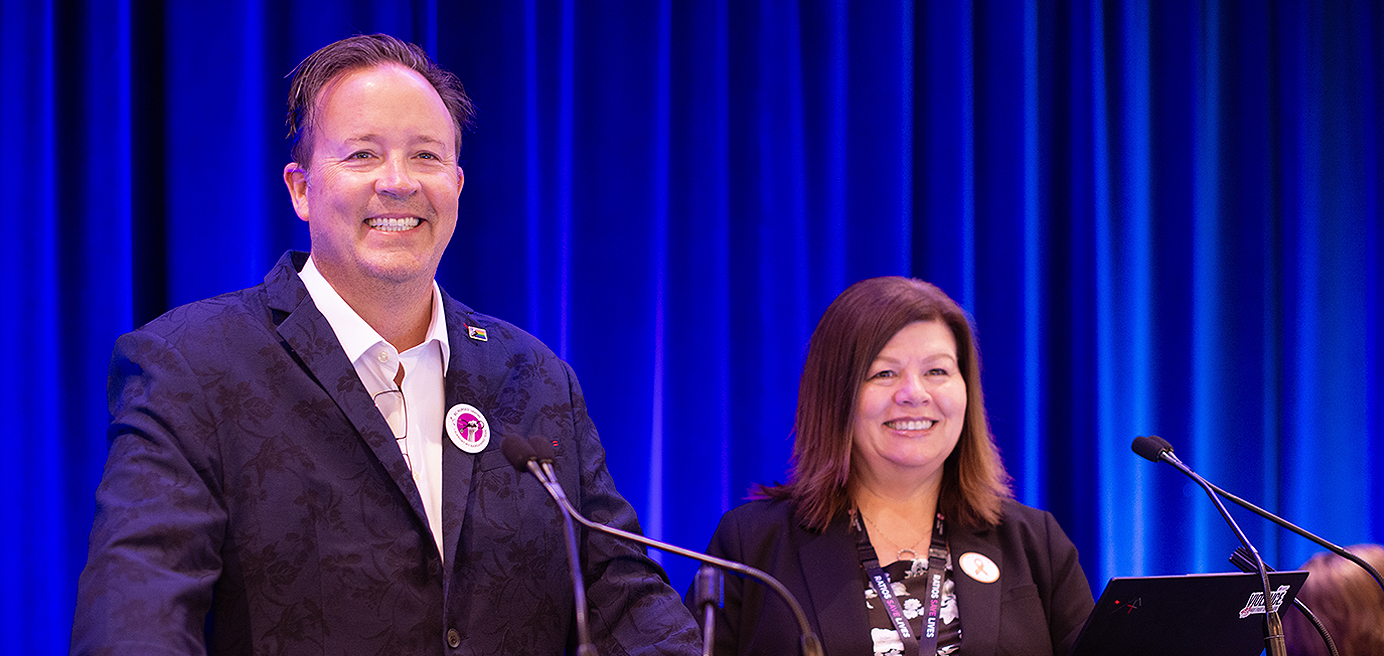
BCNU’s 44th annual convention opened on the traditional, ancestral and unceded lands of the Musqueam, Squamish and Tsleil-Waututh peoples. Union president Adriane Gear began by thanking Nuxalk and Onondaga hip hop and spoken word artist JB the First Lady for welcoming delegates to Vancouver.
Joined by BCNU CEO and Nurses’ Bargaining Association (NBA) chief negotiator Jim Gould, Gear reflected on a year shaped by progress and collective action amid growing pressure on a strained health-care system, while making it clear that nurses have entered a decisive moment.
“When nurses unite, we achieve great things,” Gear said, pointing to the impact of members’ sustained advocacy in pushing long-standing issues to the forefront.
Gear and Gould highlighted efforts underway to implement minimum nurse-to-patient ratios across the province. They emphasized BCNU’s central role in advancing, planning and implementing this work, while acknowledging the gap between policy and practice in many workplaces.
“The fight for ratios isn’t over,” Gear said, citing ongoing challenges with staffing, compliance and accountability.
Gould said ratios are beginning to make a difference where they are in place, but he emphasized that they exist within a system still under enormous strain. Short staffing, rising violence and increasing patient acuity continue to undermine the safety of nurses across the province.
Gear and Gould cited research and member data to outline the consequences of understaffing for both patient care and nurses’ well-being. Gear said these pressures are being felt on every shift resulting in nurses considering leaving the profession altogether.
Workplace violence remains a central concern. Gear and Gould shared examples from across the province to illustrate the violence that remains a daily reality in many care settings. Gear reiterated that violence is not part of a nurse’s job and said BCNU will continue to push government and employers to take meaningful action to improve safety.
The current round of NBA negotiations dominated the report. Both leaders emphasized that bargaining has reached a critical juncture. Gould spoke about the transformative history of nurses’ job action in British Columbia and the union’s preparations for bargaining, including member engagement and surveys, before outlining the challenges encountered at the table.
He said the employer has failed to make meaningful progress on key priorities, including benefits, and instead forced critical issues into arbitration. Gould described the recent decision by Arbitrator Vince Ready to cap massage therapy benefits as a step backward for nurses who rely on these supports to stay healthy on the job.
“These benefits are not luxuries. They are essential,” Gould said.
With limited movement at the table and continued employer resistance, the bargaining committee declared an impasse, stepped away from negotiations and authorized a strike vote on April 20. Gear and Gould announced the province-wide vote will take place May 8 to 11.
The leaders said a strike vote reflects the seriousness of the issues nurses face and the need to take action to pressure the employer to negotiate. They emphasized that the strike vote is a critical step that demonstrates members’ power and unity. “A strong strike vote is the ultimate exercise of members’ power,” Gould said, adding that it sends a clear message that nurses are united and prepared to act. “We have the collective strength to win what nurses deserve.”
Gear and Gould reminded delegates that a strike vote does not mean an immediate strike, but it is an essential step in applying pressure and returning to meaningful negotiations.
Closing the report, Gear underscored the role members have played in bringing the union to this point through advocacy, solidarity and a shared commitment to improving care.
“This round of bargaining is critical,” she said. “What we do here will have lasting impacts across British Columbia.”
The message to members was direct “Vote YES.”