

 Full Steam Ahead
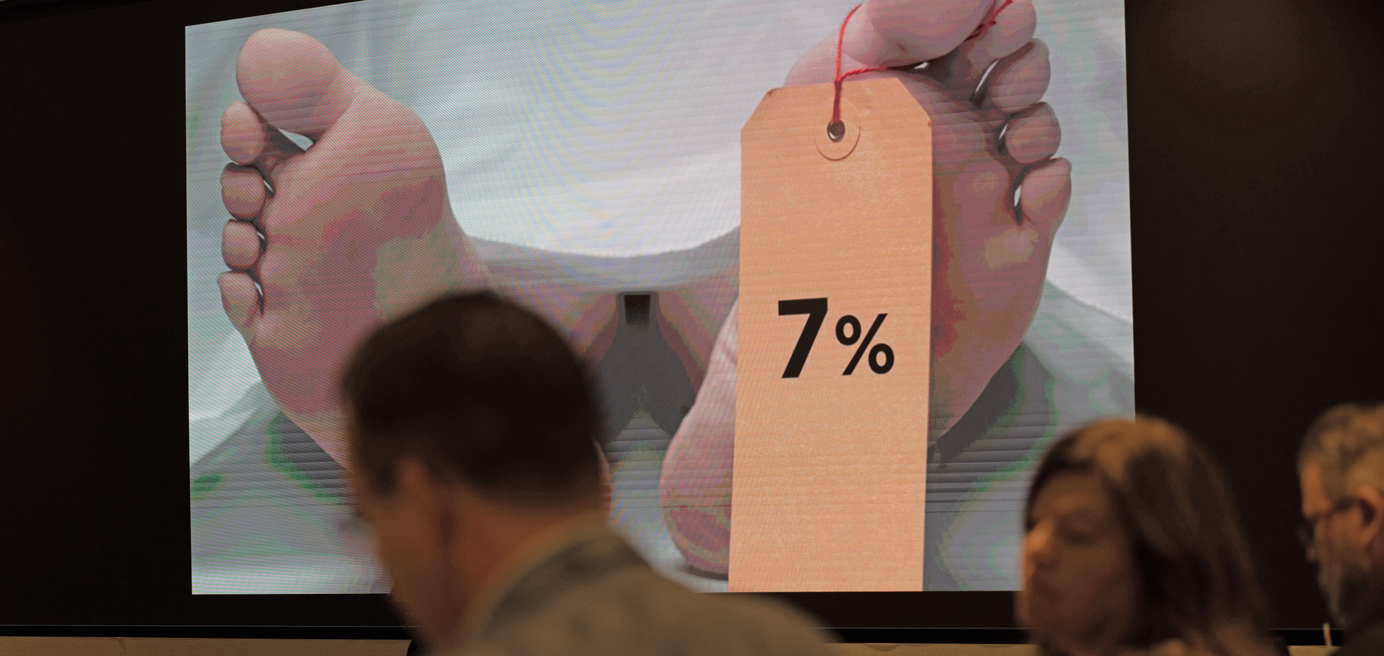
PREVENTABLE NBA chief negotiator Jim Gould told health employers that understaffing leads to preventable deaths with a stark graphic showing the 7 percent increase in patient mortality due to unsafe nurse-to-patient ratios.
BCNU CEO and chief negotiator Jim Gould had no intention of soft-pedaling the launch of Nurses’ Bargaining Association (NBA) contract negotiations in Victoria this October. Flanked by the NBA bargaining committee – including BCNU president and committee chair Adriane Gear, BCNU members from across the province, and representatives from other constituent health-care unions – his opening remarks painted a grim portrait of the current state of the nursing profession – and the desperate need for change.
“Our health-care system is in crisis.”
BCNU CEO and chief negotiator Jim Gould
Standing in front of a display of signs from more than two decades of BCNU’s violence-prevention campaigns, Gould delivered the hardest-hitting opening statement in the NBA’s recent history.
“Health care is still at a breaking point, and everyone knows it,” he said, gesturing toward a slide filled with recent headlines documenting escalating violence in BC health-care workplaces.
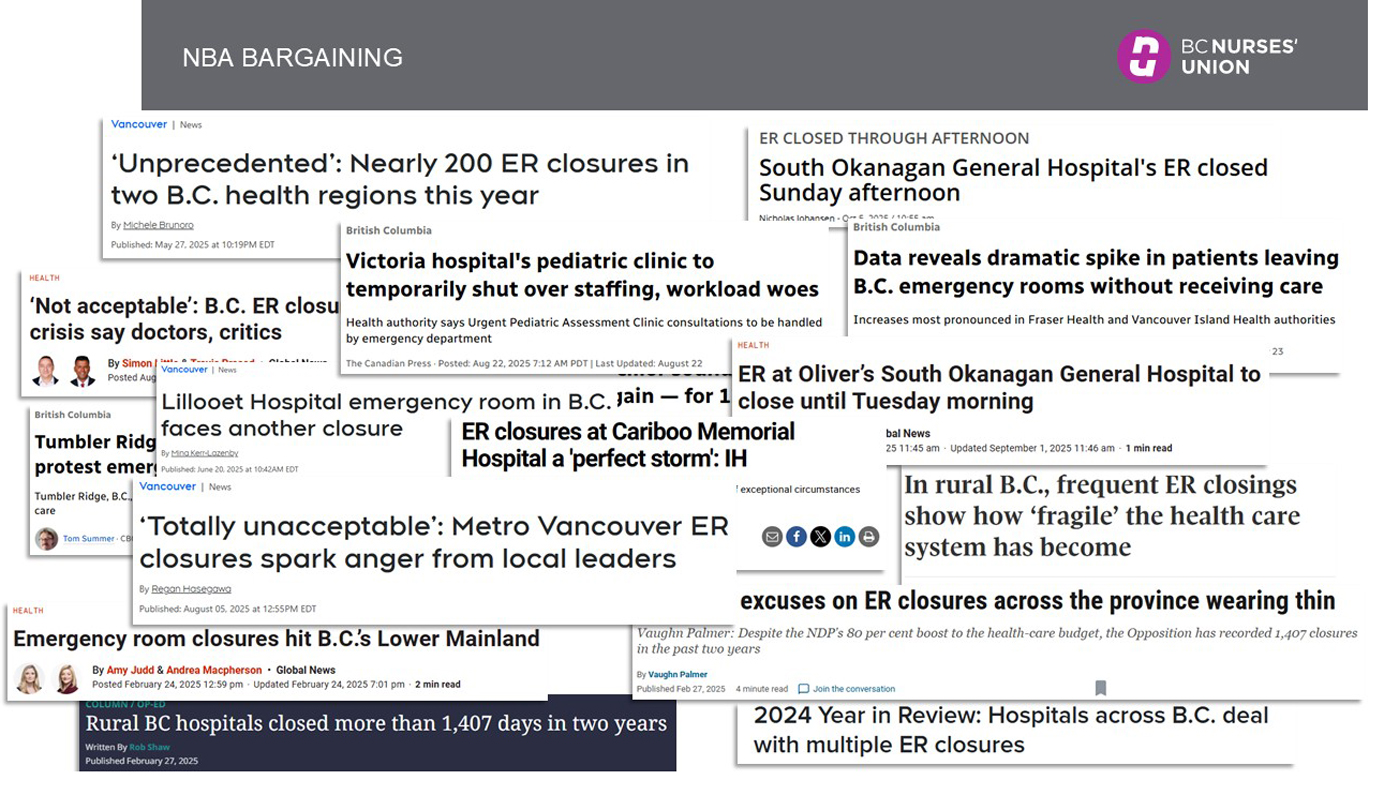
RIPPED FROM THE HEADLINES BCNU’s opening bargaining statement held government and health authorities to account for years of inaction on violence in health care.
Armed with extensive bargaining survey data, academic research, government workforce forecasts, and the testimony of thousands of BCNU members, Gould argued that the stakes of this bargaining round are higher than ever. Nurses continue to leave the profession at alarming rates, violence in health care continues to escalate, workloads remain unsafe, and the health-care system is rapidly losing its ability to recover, he said.
“This system has survived on the backs of the nursing workforce.”
BCNU CEO and chief negotiator Jim Gould
BCNU’s bargaining survey has revealed that more than one in five members is strongly considering quitting nursing – or already planning their exit. Unsafe work conditions continue to plague BC’s nursing workforce, leading to an average of 46 time-loss claims per month – meaning one nurse is injured every 16 hours. More than half of respondents rated the psychological safety of their workplace as “poor” or “terrible.”
The broader labour market paints an even bleaker picture. The province’s own 2024 Labour Market Outlook projects 35,000 nursing openings over the next decade thanks in part to population growth and the aging of patients. When taking into account members’ stated intention to leave nursing, BC could lose up to 12,000 nurses by 2027, while local nursing programs graduate fewer than 2,000 students each year.
Meanwhile, Alberta’s top nursing wage is set to outpace BC’s by 2026. Paired with BC’s status as Canada’s most expensive province, our health-care system risks further shortages.
Sitting across from representatives from the Health Employers’ Association of BC (HEABC), Gould was blunt: “I say there isn’t a nursing shortage. Rather, there is a shortage in trained professional nurses who are prepared to tolerate the working conditions as they currently exist in BC.”
Employer Cites Financial Woes
Across the table, HEABC representatives focused on emphasizing the reeling financial situation left by the Trump administration’s trade war with Canada. HEABC president and CEO Michael McMillan said the provincial government has instructed employers to maintain “fiscal responsibility” in this round of bargaining. McMillan praised nurses for their commitment to patient care.
Lead HEABC negotiator James Suderman listed employer priorities, including addressing workforce needs, and strengthening staffing levels in the pursuit of high-quality patient care, He pointed to minimum nurse-to-patient ratios as an area of shared interest between health employers and nurses, and noted this round of bargaining presents opportunities for improvement. Like McMillan, Suderman described the financial environment as complex and challenging.
Gould responded to the employers’ spokespeople with a stark warning: failing to invest in nurse retention and recruitment threatens the sustainability of BC’s health-care system and puts patients’ lives at risk. He cited a recent study of BC hospitals by researcher Linda Aiken observing a seven percent increase in preventable deaths for every additional patient above safe ratios. Aiken’s study also confirms what members have been saying for years: unsafe workloads are the number one reason they plan to leave their jobs.
He then confronted the employer with a startling figure: a 31-fold increase in government spending on agency nursing between 2018 and 2024. Gould reminded employer representatives that these private, for-profit agencies bled more than $271 million in tax dollars in the last fiscal year alone, a direct result of poor workforce planning and disastrous retention rates.
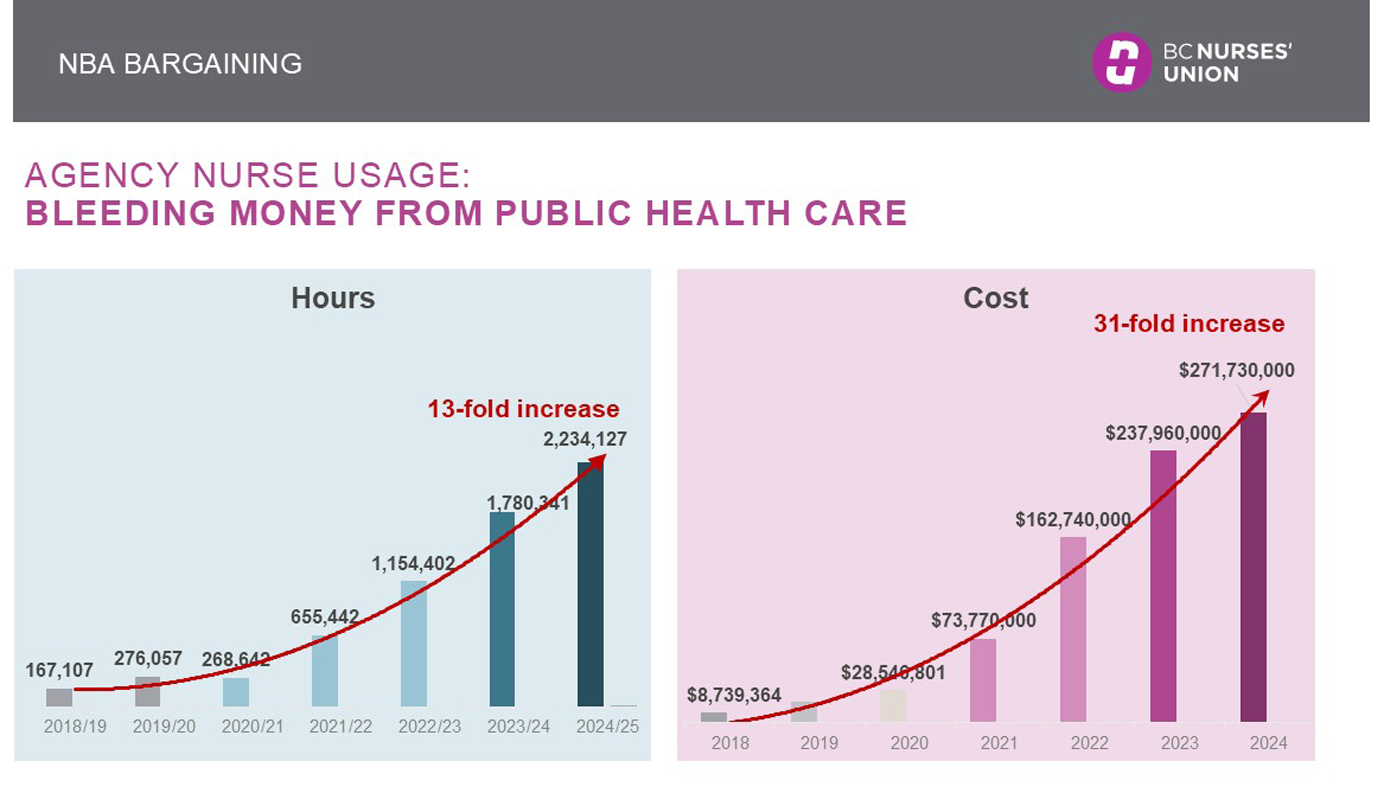
OUT OF CONTROL The use of agency nurses has skyrocketed since the COVID-19 pandemic, bleeding money out of the public health care system
“This system has survived on the backs of the nursing workforce,” Gould concluded. “It’s time to stop throwing good money after bad. Decisions from past leadership have ignored nurses, ignored the needs of health-care workers, and ignored the needs of patients.”
“Nursing is not safe.”
On the first day of bargaining, BCNU president and NBA bargaining committee chair Adriane Gear delivered a stark portrait from the front lines – one marked by violence, trauma, and moral injury.
“In Victoria, one member was strangled unconscious. In Fraser Health, a man wielding a machete threatened patients. In interior health, a nurse was attacked after a patient hid on a psych unit. This nurse’s injuries seriously affected her life.”
“If government and employers do not address workplace violence, we simply won’t retain the workforce needed to implement minimum nurse-to-patient ratios and provide the high-quality care patients deserve.”
BCNU President Adriane Gear
Gear emphasized the intense physical and emotional demands of nursing – working short-staffed, bearing witness to human suffering, and struggling with moral injury while trying to deliver care.
“Nurses are punched, kicked, spat on, verbally and physically assaulted on the job,” she said. “If government and employers do not address workplace violence, we simply won’t retain the workforce needed to implement minimum nurse-to-patient ratios and provide the high-quality care patients deserve.”
She also warned that short-sighted cuts to health-care benefits will compromise the work done to retain and recruit nurses, undermining the health-care system in the long run.
Restricting massage and physiotherapy, she noted, would directly increase sick time, reduce shift uptake, increase long-term disability costs and drive nurses away from the bedside.

FRONT AND CENTER The NBA’s opening presentation put nurses’ voices at the heart of bargaining.
Safety first
As talks continued through November, health and safety issues continued to dominate negotiations. Gear delivered a pointed message during the third bargaining session in Victoria: “Nurses have been betrayed by their employer and others responsible for keeping us safe. We have been treated as disposable, expected to show up for British Columbians without being taken care of ourselves.”
BCNU presented 16 health and safety proposals aimed at keeping nurses and patients safe, including AI weapons detection, creating clear and enforceable processes for reporting psychological hazards in the workplace, and improving WorkSafeBC and long-term disability benefits.
Workers continue to build power
BCNU is not the only union at the bargaining table. Nurses have been supporting other union members and showing that solidarity wins. With BCNU members proudly at their side, public service members of the BC General Employees' Union (BCGEU) undertook an eight-week-long strike that forced their employer, the provincial government, back to the table and demand improvements to wages and working conditions despite a tight fiscal climate.
Members of Unite Here Local 40 also secured major wage gains after a 77-day-long picket line fight with their employer – the longest hotel strike and lockout in Victoria’s history. Meanwhile, workers at Canada Post reached an agreement in principle in November. These union members took heroic job action that saw unprecedented government interference and massive company losses.
“Nurses have been betrayed by their employer and others responsible for keeping us safe.”
BCNU President Adriane Gear
The BCGEU agreement features a wage raise of 12 percent over four years, far exceeding the government’s initial offer of 3.5 percent over two years. The Facilities Bargaining Association – which covers over 67,000 health care support workers across the province, also negotiated a wage package that will see a 12 percent raise over the four years of the agreement. Thanks to the sacrifice of BCGEU members, other public sector unions, including BCNU, can expect to receive the same wage offer.
Members will decide this round
With an extremely difficult round of negotiations ahead, NBA members need to get ready to demonstrate unprecedented unity and remain steadfast. That goes double now that the employer is attempting to use arbitration to force changes to members’ health-care benefits plan.
In early October, health employers notified the NBA that they intended to enforce a Jan. 1, 2026 deadline for members to choose between two options: a reimbursement limit on massage therapy or an enhanced flex benefits account. This deadline was set out in Appendix U.2 of the provincial collective agreement, and dates back to 2019, when the parties agreed to cost-saving measures.
BCNU strongly argued against the employer’s attempt to enforce the deadline at an arbitration hearing later that month, insisting that decisions that directly affect members’ benefits must be negotiated transparently and collectively at the bargaining table.
Recently, Arbitrator Vince Ready issued an interim award directing the NBA and health employers to set a new date to select and implement a benefits plan model by Jan. 30, 2026, stating that he will determine a date if the NBA and HEABC cannot come to a decision.
That’s why BCNU President Gear is calling for unprecedented unity from NBA members as the union prepares to fight back with every tool available.
“Our solidarity is more important than ever right now, so it’s important that folks stay informed and engaged,” said Gear. “Your involvement is critical this round.”
Members are encouraged to keep their personal email up to date in the BCNU Member Portal, subscribe to email updates, and follow BCNU on Facebook, Instagram, and YouTube.
The new BCNU app, launched in November, offers NBA bargaining updates, member bulletins and news releases, bargaining education modules, surveys and quick polls, and full access to the NBA collective agreement with enhanced search tools.
While Gould has cautioned members about the challenges ahead, he is optimistic about the potential outcome of this round.
“BCNU members are proving they are among the most engaged unionized nurses in Canada,” he remarked. “And that strength shows at the table.”
UPDATE (Winter 2025)
By the numbers – BCNU bargaining survey
Ahead of bargaining, BCNU sent NBA members a benefits-focused survey with questions about their use of massage therapy, physiotherapy, and needed improvements to other health-care services. Over 20,000 members – roughly 40 percent of the NBA – responded within a few days of its launch, showing NBA members’ strong resolve to preserve 100 percent employer-paid benefits.
Massage & Physiotherapy
- Members average 22 massage sessions per year
- 75 percent say a cap on massage therapy would negatively affect their ability to work.
- 78 percent would take more sick time
- 57 percent would leave bedside care
- 54 percent would pick up fewer shifts
- 25 percent would consider leaving the profession
- Members average 12 physiotherapy visits per year
Priority Improvements:
- Vision Care
- Dental Care
- Counselling
- Drug coverage
- Chiropractic