
 Equity Insights
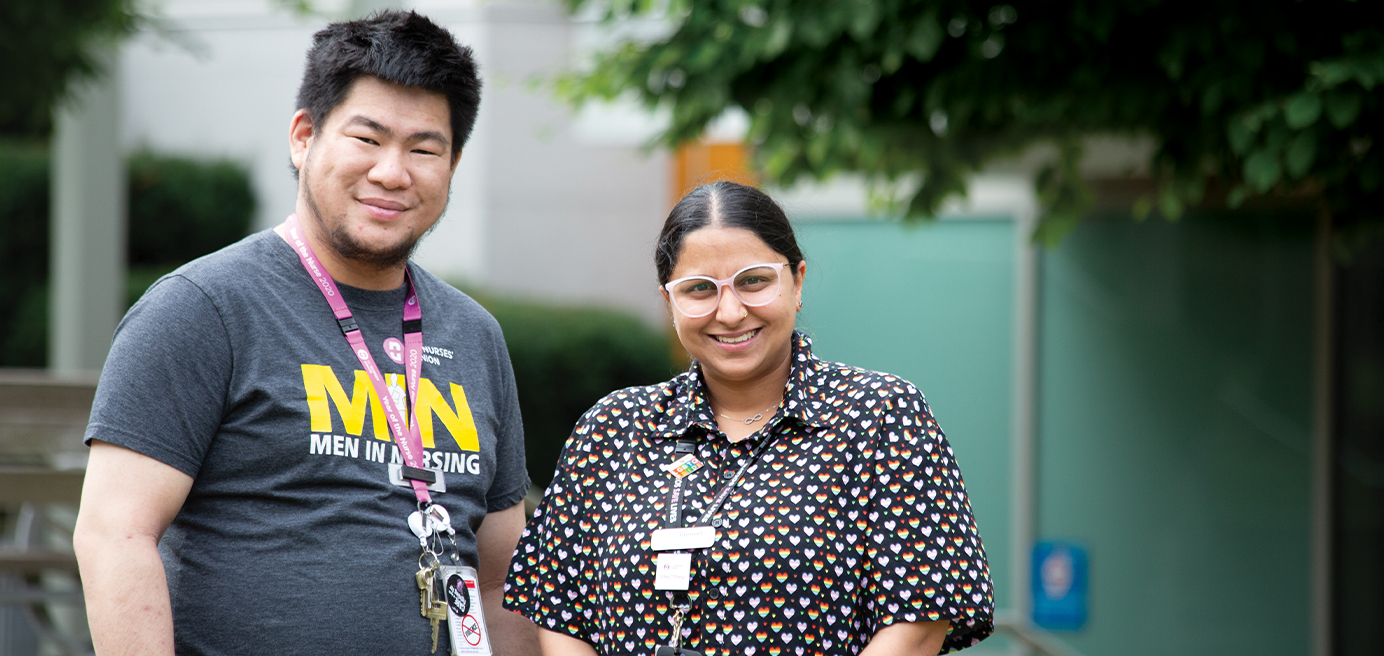
EQUITY ORGANIZERS BCNU Central Vancouver region Men in Nursing network rep Xavier Yee and 2SLGBTQ+ caucus rep Gurneet Kaur Tatla organized a survey with other human rights and equity reps in their region to gather nursing perspectives on equity, inclusion and cultural safety.
This spring, BCNU members at Vancouver General Hospital nursing stations, staff lounges and break rooms came across hundreds of brightly coloured plastic easter eggs inviting them on a journey of reflection.
Inside each egg was a slip of paper with the question “what does an equitable, inclusive and culturally safe workplace look like to you?” A QR code led to a survey, where participants could share their thoughts and experiences.
The survey was the centrepiece of the BCNU Central Vancouver region’s Spring Equity Egg Hunt, a member engagement initiative led by the region’s 2SLGBTQ+ and Mosaic of Colour caucuses along with the New and Young Nurses and Men in Nursing networks.
BCNU proudly supports four human rights and equity (HRE) caucuses and three networks, which are active across all of the union’s 16 regions. These groups contribute to creating more just and equitable workplaces and a union that is safe and welcoming for all.
The Spring Equity Egg Hunt survey is just one example of this work. The results were analyzed and used to develop a series of recommendations for health employers to effectively support and advance workplace equity (see sidebar).
Gurneet Kaur Tatla (pronouns: she/they) is BCNU’s Central Vancouver 2SLGBTQ+ caucus rep. She says the collaborative spirit of the initiative reflects the collective solidarity at the heart of equity organizing.
“Our members can identify with different communities and have very different lived experiences,” they note. “Working together gave us a chance to bring those different perspectives into one space where people could feel supported, respected and included.”
There was also a practical benefit to organizing the event together. By pooling their budgets, the HRE reps increased their capacity to make a larger impact.
“It allowed us to do something bigger, better and more fun for the membership,” says Xavier Yee, BCNU Central Vancouver region’s Men in Nursing Network rep.
The collaboration was rooted in a shared goal: creating a playful, interactive and accessible way for members to share their vision of a safe workplace and reflect on questions of diversity, equity and inclusion in the nursing profession.
A Story in Every Egg
The reps were impressed by the survey response that saw 436 anonymous entries, 223 of which provided substantive data for analysis.
The responses showed that most nurses possess a strong conceptual understanding of equity, inclusion and cultural safety.
One of the clearest findings was the importance of respect. Participants consistently identified respect as foundational to creating inclusive and culturally safe workplaces.
Tatla says this finding highlights how equity is experienced through everyday interactions, not just policies and programs.
“What stood out the most was how often people came back to something as simple as respect,” she remarks. “We talk about equity, inclusion and cultural safety in a lot of different ways, but when members had the opportunity to tell us what that actually looks like to them, so much of it came back to how they are treated in their everyday work.
"Feeling respected, being able to speak up, being heard and feeling like they belong were all important.”
Those relational dynamics, however, are shaped by broader structural conditions. Staffing levels, workload demands and system pressures were frequently identified as critical structural barriers to achieving equitable and culturally safe workplaces.
“I was surprised by how much staffing, workload and working conditions came up in the responses,” Tatla remarks.
The findings underscore that equity work cannot stop at education and awareness. Members also identified the importance of adequate resources, safe workloads, supportive working conditions and leadership that listens and acts.
“Having a fair workload, feeling safe to raise concerns and having the right supports and resources are also part of what an equitable workplace looks like,” says Tatla.
For the organizers, the survey demonstrated the value of member-driven engagement initiatives in informing organizational and union priorities. The findings offer lessons for building safer and more inclusive workplaces, while the full survey report includes recommendations for health employers.
“The biggest takeaway from this experience was how much our members had to say when we created a fun, interactive and accessible way for them to share their experiences and ideas.” •
10 LESSONS ON WORKPLACE SAFETY
Respondents to BCNU Central Vancouver region’s Vancouver General Hospital Spring Equity Egg Hunt survey provided a wealth of experiences that revealed 10 important lessons on equity and workplace safety.
The findings were gathered by the region’s human rights and equity representatives Gurneet Kaur Tatla (2SLGBTQ+ caucus), Simran Bir (Mosaic of Colour caucus), Khairat Moshood (New and Young Nurses network) and Xavier Yee (Men in Nursing network).
- Equity work starts with how we treat one another every day.
Respect is the foundation equity is built on. This means:- Recognizing each person’s identity and individuality
- Valuing all staff, regardless of role, background or experience
- Creating workplaces free from bullying, discrimination, and microaggressions
- Treating colleagues with the same dignity expected in patient care
- Cultural safety is both a practice and a workplace environment.
A culturally safe workplace supports individual and organizational capacities for cultural awareness and cultural responsiveness. This looks like:- Respect for different cultural traditions, beliefs and languages
- Access to interpretation and communication supports
- Continual opportunities to learn and practice inclusive approaches to communication
- Recognition that cultural safety is important for both patients and workers
- Psychological safety is not simply the absence of fear, but the presence of support
Being able to speak up without fear, especially when navigating work hierarchies, is harder for new graduates and internationally educated nurses, who may experience the workplace differently from more senior staff, and find it difficult to question or challenge what is happening around them. Psychological safety means:- Being able to ask questions or raise concerns without judgment or retaliation
- Knowing that reporting a safety concern will be taken seriously
- Having organizational systems that protect people who speak up
- Feeling empowered to use your voice, particularly in difficult situations
- Equitable workplaces are not possible if people don't have the resources or capacity to do their jobs safely.
The experience of equity is directly connected to the conditions of work. Structural barriers that negatively impact nurses’ experiences of safety, equity and inclusion at work include:- Unsafe staffing ratios
- Inequitable workloads
- Burnout
- Limited resources
- Treating everyone the same isn't always fair. Equity asks what each person needs to feel safe and included at work.
Fairness means recognizing that people have different circumstances and therefore may need different forms of support. These supports can include:- Tailored support for new graduates and internationally educated nurses
- Workloads that reflect patient acuity rather than simply patient numbers
- Transparent access to opportunities
- Supports that respond to individual needs and experiences
- Inclusive environments allow people to feel safe and comfortable in expressing who they are.
Authentic belonging means being able to:- Show up as your “full self”
- Express your identity without fear
- Feel that you genuinely belong
- Experience belonging rather than tokenism
- Equity is shaped, built, and bolstered in every shift and in everyday interactions with co-workers.
Relationships with colleagues are an important part of an equitable workplace when they value:- Mutual support and collaboration
- Peer teaching
- Mentorship
- Strong interpersonal relationships
- Equitable work environments require individuals and organizations to create opportunities for continuous learning and reflection.
Equity education should go beyond one-off training sessions and be more robust and comprehensive. This education can include:- Ongoing cultural safety education
- Anti-racism training
- Opportunities to learn from real workplace experiences
- Continued conversations about bias and discrimination
- Learning that is reinforced over time
- Inclusive communication styles help people feel heard and affirmed in knowing that what they have to say matters.
Communication is an important mechanism for equity. This looks like:- Open and honest dialogue
- Inclusive language
- Respect for names and pronouns
- Having concerns taken seriously
- Creating space for people to be heard
- Equity work cannot depend entirely on individual nurses or teams. Leaders must be willing to listen, act, and be accountable for what changes.
Organizational leaders must:- Focus on accountability over performative commitments
- Actively address inequities
- Cultivate responsive and approachable managers
- Commit to meaningful follow-through when concerns are raised
- Take visible action, not simply enact policies or make statements
Read the full report.
UPDATE (Summer / Fall 2026)