
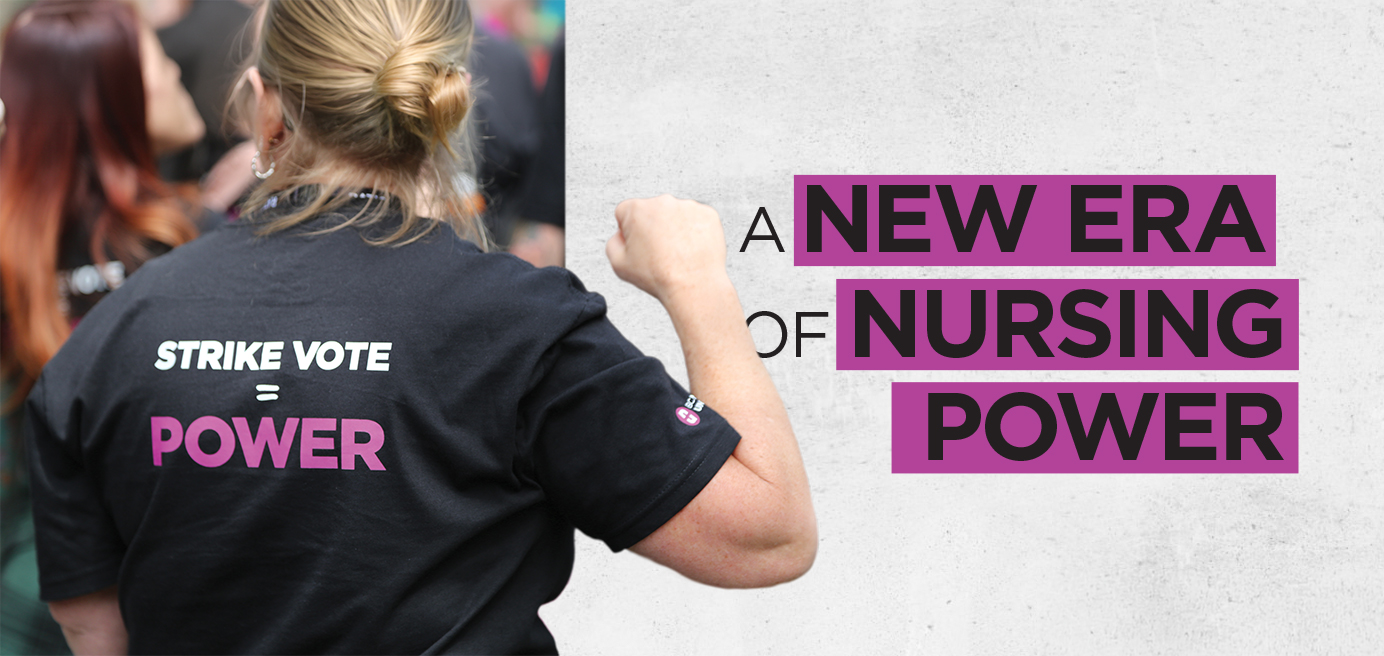
 A New Era of Nursing Power
After years of worsening conditions, BC nurses’ first job action in decades sets the stage for a battle to redefine nursing power
“The whole world is watching us.”
Those words from BCNU President Adriane Gear captured the nervous energy in the room as members of the Nurses’ Bargaining Association (NBA) provincial bargaining committee awaited the results of a province-wide strike authorization vote.
Held during National Nursing Week 2026, the May vote capped months of mounting frustrations as the NBA attempted to negotiate a fair collective agreement with the Health Employers’ Association of BC (HEABC).
After months of fruitless negotiations, that frustration was boiling over. Through dozens of bargaining sessions, HEABC had still only accepted four of more than 100 NBA proposals – each representing carefully crafted solutions to longstanding issues like violence in the workplace, burnout and unsafe nurse-to-patient ratios.
“We weren’t getting anywhere with them,” said Gear. “HEABC refused to offer any substantive contract improvements or commit to funding they’d already agreed to in negotiations with other public sector unions. It was incredibly frustrating.”
“We weren’t getting anywhere with the employer. They refused to offer any substantive contract improvements. It was incredibly frustrating.”
- BCNU President Adriane Gear
But when the results of the vote came in, the mood shifted quickly – to jubilation.
Over 98 percent of members had voted “yes” to authorize a strike, signaling their willingness to take job action and fight for what they deserve. Even more impressively, more than 50,000 members took part in the vote – a massive turnout that made this one of the strongest strike mandates in Canadian labour history.
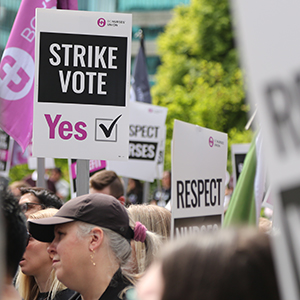
But this result wasn’t just a ballot count, nor was it just another ordinary step in a long bargaining process. It was a turning point.
The vote came to symbolize the unity of BC’s nurses at a critical time. Away from the bargaining table, members had been losing faith in their employer’s willingness and ability to address rampant problems in health care. Nurses have spent years telling the employer what wasn’t working: chronic short staffing, excessive workloads and escalating violence. Despite bringing forward solutions, conditions kept deteriorating.
Something had to change.
“NBA bargaining used to take place in an atmosphere of collaboration,” recalls NBA chief negotiator and spokesperson Jim Gould. “While collaboration with HEABC can at times be valuable, our experience at the bargaining table was devoid of collaboration. It was a flat ‘no’ to almost everything we proposed.”
And now, with a 98.2 percent strike vote in hand, the NBA was ready to lead that change. The strike vote represented a massive shift in the relationship between nurses and their employer. The fight was on.
The road to job action
The strike vote made one thing clear – members had the resolve needed to force change. However, decades of peaceful contract negotiations had left a long gap in the NBA’s experience of planning for job action. That gap needed to be filled quickly.
BC’s nurses last walked picket lines in 2001, during a fight over then-Premier Gordon Campbell’s anti-union Bill 15. That legislation tore up health-care union contracts and stripped BCNU members of their right to take job action. In response, BCNU led illegal wildcat strikes at 14 hospitals across the province.
Before that, a 1989 strike saw a non-nursing duty ban after the employer tried to strong-arm concessions during contract negotiations. Some 94 percent of members voted to strike and picket lines went up at 69 facilities in the weeks that followed.
These two major job actions in 1989 and 2001 showed that nurses were willing to do what it takes to achieve a stronger contract. But BCNU now had gone a long 25 years without any job action practice – and most of the nurses with on-the-ground experience in those two conflicts had since retired. The union needed a plan.
Provincial job action committee (PJAC) chair Sharon Sponton started building that plan immediately after the committee was elected at BCNU’s 2025 convention. Sponton and her PJAC colleagues began planning sessions in the summer of that year, then held bi-weekly meetings to update BCNU’s blueprint for job action, forecast potential job action scenarios, troubleshoot issues and launch online education modules to fill members in on their role.
It was a big job. But it was one that members of the committee felt compelled to do.
“It’s one of those rare moments when we can all come together for something fair.”
- BCNU provincial job action committee chair Sharon Sponton
“There’s a deep sense of collectivity and solidarity in this work,” says Sponton. “It’s one of those rare moments when we can all come together for something fair. It can be incredibly motivating and meaningful.”
The committee also enlisted the help of BCNU’s regional leadership to prepare members for what might come.
In PJAC member Gina Neumann’s region, a picket drill helped work out the kinks in their local job action plan and get members fired up.
“We set up a picket line and went through every possible scenario: What do you do if you work from home? Where do members park? What forms do they need?” For Neumann, the drill was not only successful from a planning perspective – it showed her that her region had the right attitude for successful job action. “The mock strike was incredibly well received. It was the highest-rated event at our annual general meeting.”
Meanwhile, at the BCNU provincial office in Burnaby, staff were doubling down on efforts to have everything in place for job action, printing signs and other materials, setting up phone bank workstations and a command centre and ensuring the regions had what they needed to support members on the ground.
“We know this strike vote had an impact at the table.”
- BCNU President Adriane Gear
A Turning Point in Negotiations
While the PJAC laid the groundwork for job action, the 98.2 percent strike vote did what it was designed to do – it forced the employer back to the bargaining table.
When the NBA provincial bargaining committee returned to negotiations after the strike vote, they immediately noticed a change in the employer’s willingness to move on key items.
“Discussions felt more constructive than they were earlier in bargaining,” said Gear. “We know this strike vote had an impact at the table.”
That tone shift at the table enabled both sides to reach agreement on several critical items, including a general wage increase of 12 percent over four years, increases to premiums and benefits and significant additional funding for minimum nurse-to-patient ratios, alongside other contract improvements. After a marathon week of bargaining, including 22-hour long sessions at the table, the committee reached a tentative agreement in the wee hours of May 21.
As Gear observed, the employer’s changed demeanor at the table came down to one thing – members demonstrated they were willing to act.
“Make no mistake, every member played a role in reaching this moment,” she said. “This tentative agreement was not handed to nurses – they fought for it.”
The bargaining committee then spent the next several weeks familiarizing members with the deal, traveling to Prince George for a Provincial Ratification Summit with union activists and holding townhalls in Victoria, Vancouver, Langley and Kelowna alongside multiple virtual events.
Despite the distance travelled, both around the province and at the bargaining table, for many nurses, the tentative agreement fell short.
In a ratification vote held from June 15–19, 67 percent of members who participated voted to reject the tentative agreement.
It was a clear signal to negotiators on both sides of the bargaining table that nurses weren’t willing to put up with chronic understaffing, increasing workloads and scope, workplace violence, burnout and a health-care system that continued to ask too much from those providing care.
It also showed the depth of solidarity members had built – and how far they were willing to go to fight for what they deserve.

GETTING INFORMED Hundreds of BCNU activists gathered in Prince George on May 26 for a Ratification Summit. Participants heard from the NBA bargaining committee and experts about the details of the contract.
On the brink
Armed with a mandate from the membership to ask for more, the NBA bargaining committee returned to the table with HEABC, again pushing for wage increases higher than the mandate the province had set for all public sector bargaining associations and other items not included in the tentative agreement.
The employer was willing to continue talking, but the key issues driving members toward job action remained unresolved. After a renewed attempt at bargaining, the gap between what nurses were asking for and what the employer was prepared to offer remained too wide to close through discussions alone.
The NBA moved quickly, advising the PJAC and BCNU council that job action was needed to accomplish the change members needed to see. On June 29, BCNU issued 72-hour strike notice to employers, leaving open the opportunity to return to the bargaining table if the employer was willing to do what it would take.
But given the months of back-and-forth and a government-issued bargaining mandate that left no room for further improvements, what happened next was inevitable.
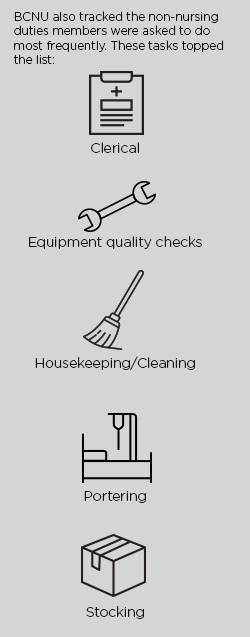
On July 2, BCNU began a province-wide non-nursing duties ban and overtime restriction. Members in all corners of BC refused to take on tasks unrelated to direct patient care, like making beds, answering phones and portering patients.
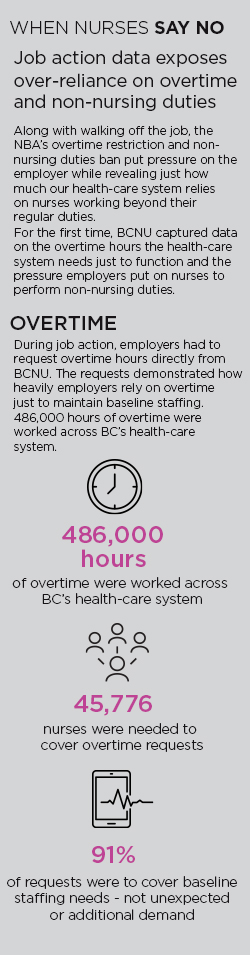
The overtime ban also now required the employer to request any overtime shifts directly from the union – enabling BCNU to capture hard data on overtime statistics that the employer previously kept hidden. Requests for overtime began pouring into the union office immediately – over 30,000 hours’ worth in the first few days. More than 90 percent of overtime hours throughout BCNU’s job action were requested just to fill to baseline staffing levels, with more than 400,000 hours requested during the whole period.
For years, nurses knew that their overtime hours weren’t just a backup plan for occasional increases in demand or temporary staffing shortages – they were the staffing plan. Now, for the first time, BCNU had the data to prove it.
On the Line
Job action quickly escalated after the non-nursing duties ban and overtime restriction. On July 7, a picket line went up at Vancouver General Hospital – the first in 25 years. Members at Surrey Memorial Hospital and the Jim Pattison Outpatient Care and Surgery Centre joined soon after on July 9, followed by Victoria General Hospital, Nanaimo Regional General Hospital, South Island Surgical Centre, Centre Island Surgical Centre and Royal Jubilee Hospital.
In total, seven health-care sites held picket lines, while members maintained the non-nursing duty ban and overtime restriction across the province. But they did so under considerable strain.
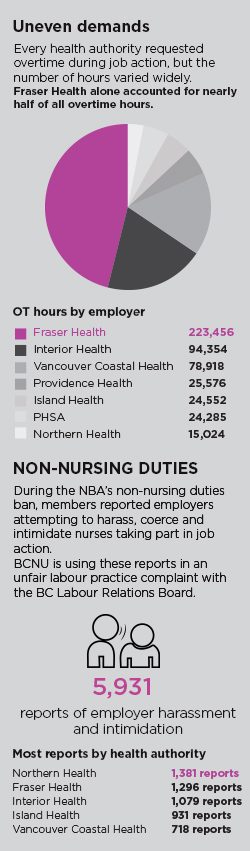
Almost immediately, employers reacted to the non-nursing duties ban with a campaign of harassment, bullying and coercion. Managers cajoled members, threatened their nursing licences and otherwise attempted to intimidate them into continuing to perform banned non-nursing duties.
“We heard outrageous things from members taking part in our lawful job action, like being told they would face discipline for refusing to make beds,” said Gear. “You cannot depend on nurses to hold the system together every day while threatening them for advocating for themselves.”
After receiving over 5,000 reports of employer backlash, BCNU launched an unfair labour practice application at the BC Labour Relations Board. At the time of writing, this application is still ongoing as BCNU continues to fight for members’ rights to lawful job action.
Members at locations without picket lines held rallies across the province, in places like Prince George, Kelowna and Trail to fight back against employer intimidation.
In every corner of the province, members turned up, spoke out and showed the employer what BC’s nurses are made of.
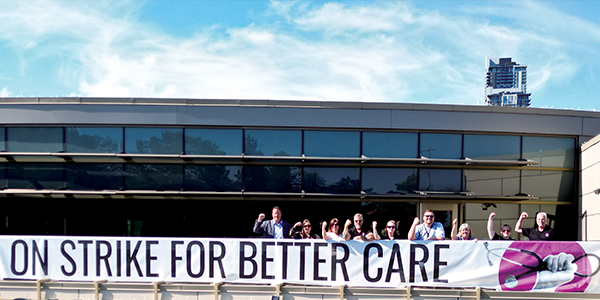
FULL STEAM AHEAD BCNU provincial office in Burnaby served as strike headquarters as the NBA bargaining committee pushed the employer to offer a fair contract.
All battles big and small
After months of bargaining, a rejected tentative agreement and weeks of job action, it became clear that the parties would not be able to reach a negotiated settlement. On July 10, the provincial government announced the appointment of special mediators Amanda Rogers and Vince Ready to resolve the NBA’s dispute with HEABC. In a gesture of good faith, picket lines came down on July 14 after mediation began, while the non-nursing duties ban and overtime restriction remained in place.
On July 24, Rogers and Ready issued recommendations, which included the use of binding arbitration to resolve the outstanding wage dispute. The NBA provincial bargaining committee made the difficult decision to accept the recommendations. BCNU council endorsed the decision, and the PJAC called an end to job action that evening at midnight.
For many members, that decision has been difficult to accept. Nurses entered this round of negotiations with high hopes for improvements and significant changes to their workplace. And on many of these items, the new NBA contract has crossed a meaningful distance – there are new provisions for occupational health and safety, increases to premiums, improvements to benefits like vision care and mental health supports and an agreement to fund the ongoing implementation minimum nurse-to-patient ratios.
But for many members, it wasn’t enough. After everything they have been through, many wanted more.
“That frustration is real, and it is fair,” says Gear. “None of us believes the health-care system will be transformed overnight. But we have pushed the issues further than they have been before because nurses across this province came together, stayed united and refused to accept the status quo.”
That challenged status quo is perhaps the strongest achievement of this historic job action.
For years, BC nurses and their employers had negotiated contracts in a calmer atmosphere. A relationship of collaboration had developed when both parties came to the table in a spirit of cooperation. This round showed what happens when that relationship stops delivering results. Nurses voted overwhelmingly to strike. They rejected a tentative agreement. They took job action across the province. They stood together in the face of employer pressure. And they forced the employer and the government to confront problems nurses have been raising for years.
While the picket lines came down, the fight is not over.
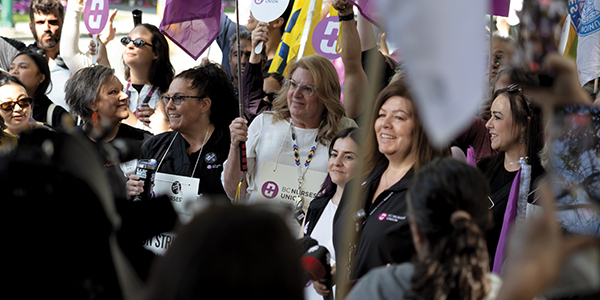
MAKING HISTORY BCNU President Adriane Gear speaks to media at BC nurses’ first picket line in over 20 years at Vancouver General Hospital on July 7. Left to right: HEU President Barb Nederpel, PJAC member Tannis Keteca, PJAC chair Sharon Sponton, BCNU Central Vancouver regional council member Kristina Hernandez, BCNU President Adriane Gear and NBA bargaining committee member Tracy Gadsby.
What’s next
“We have pushed the issues further than they have been before because nurses across this province came together, stayed united and refused to accept the status quo.”
- BCNU President Adriane Gear
Alongside binding arbitration, the recommendations also created two important new opportunities: comprehensive reviews on violence in health care and on non-nursing duties. The union’s unfair labour practice application over employer harassment and intimidation during job action is ongoing at the BC Labour Relations Board, and BCNU will continue to pursue justice for members who took part in lawful job action.
For years, nurses have been telling their employer what is happening in their workplaces. They have talked about violence, workloads and being pulled away from nursing to do work that should never have landed on their shoulders in the first place.
Now, members have another opportunity to put those experiences on the record and push for meaningful change.
In all, BCNU’s 23-day job action was the longest nursing strike in BC’s history and the second longest in Canadian history. It ended a long period of labour peace in nursing that, despite the gains made in previous contract rounds, had nonetheless seen working conditions worsen, injuries and violence escalate and ERs experience rolling closures throughout the province.
“If members maintain the solidarity and determination they have built, the new contract will not be an ending,” says Gear. “But it can be a beginning.”
-
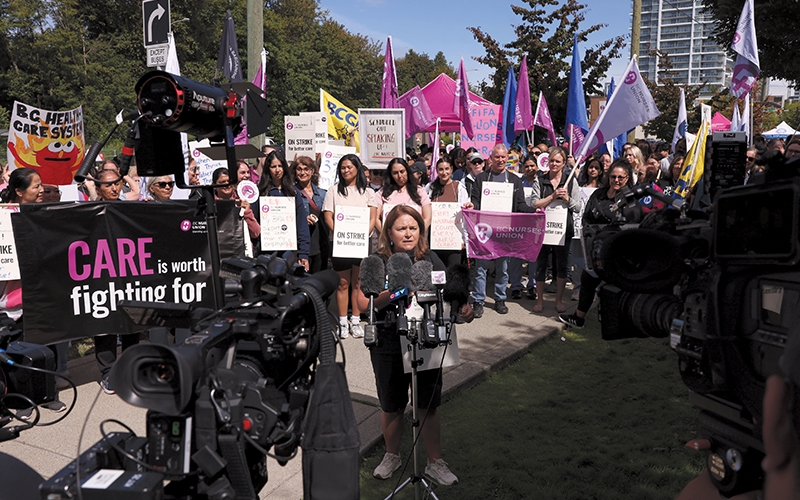 Canadian Federation of Nurses’ Unions President Linda Silas speaks in front of picketing members
-
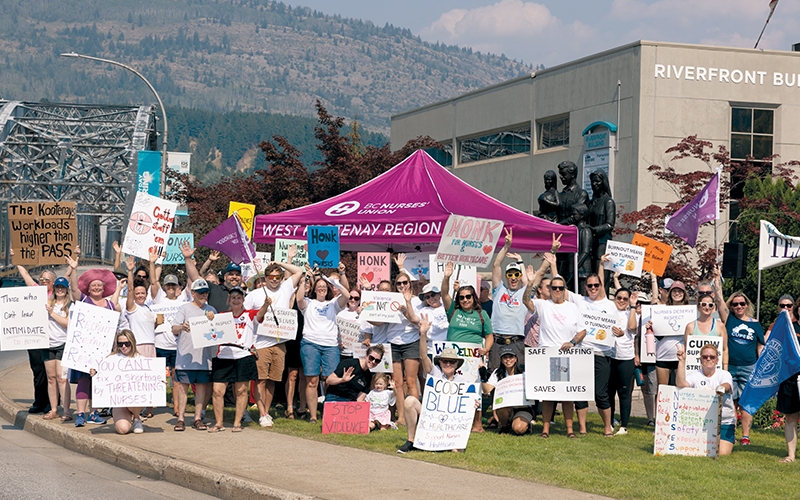 Members in Trail, Kelowna and Prince George held rallies to push back against employers attempting to intimidate members taking lawful job action.
-
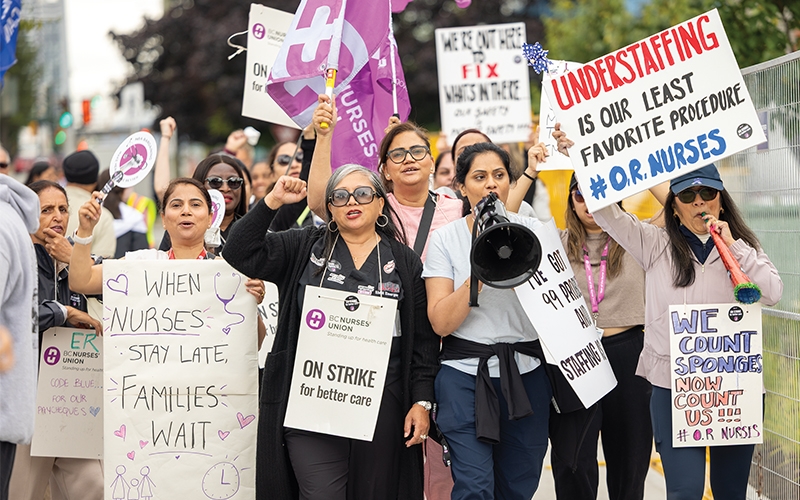 Members take part in a picket line outside of Surrey Memorial Hospital on July 9.
-
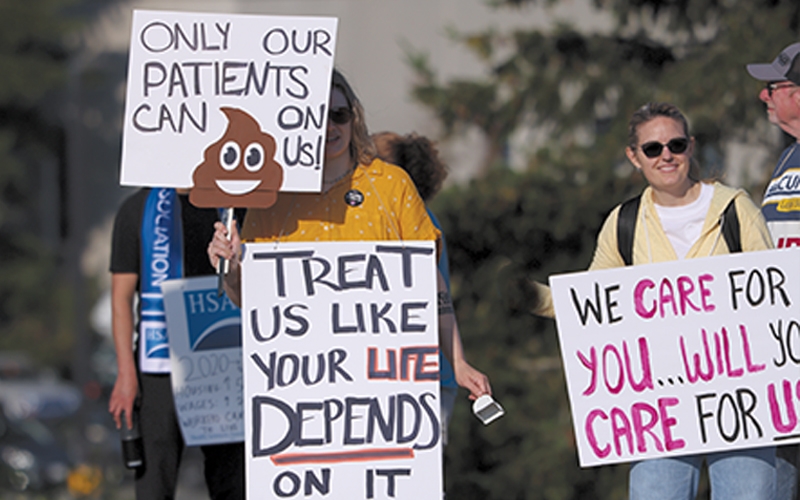 Picketers got creative – crafting signs that were hilarious, heartfelt, picturesque and poignant.
-
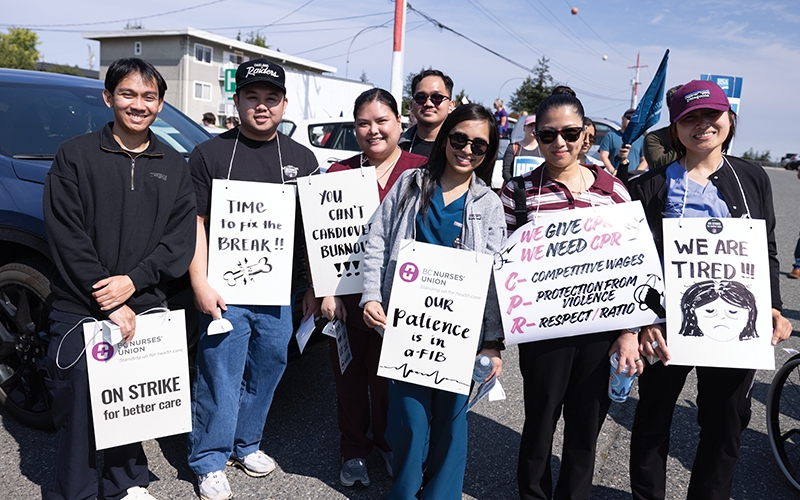 Members participate in a picket line at Nanaimo General Hospital on July 13.
-
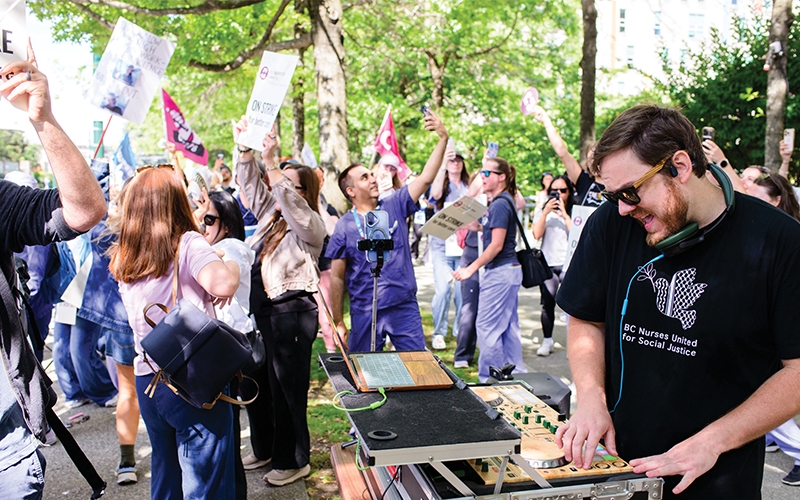 A party atmosphere kept picketers moving at the Vancouver General Hospital picket line on July 8.
UPDATE (Summer / Fall 2026)