

 Violence. Still Not Part of the Job
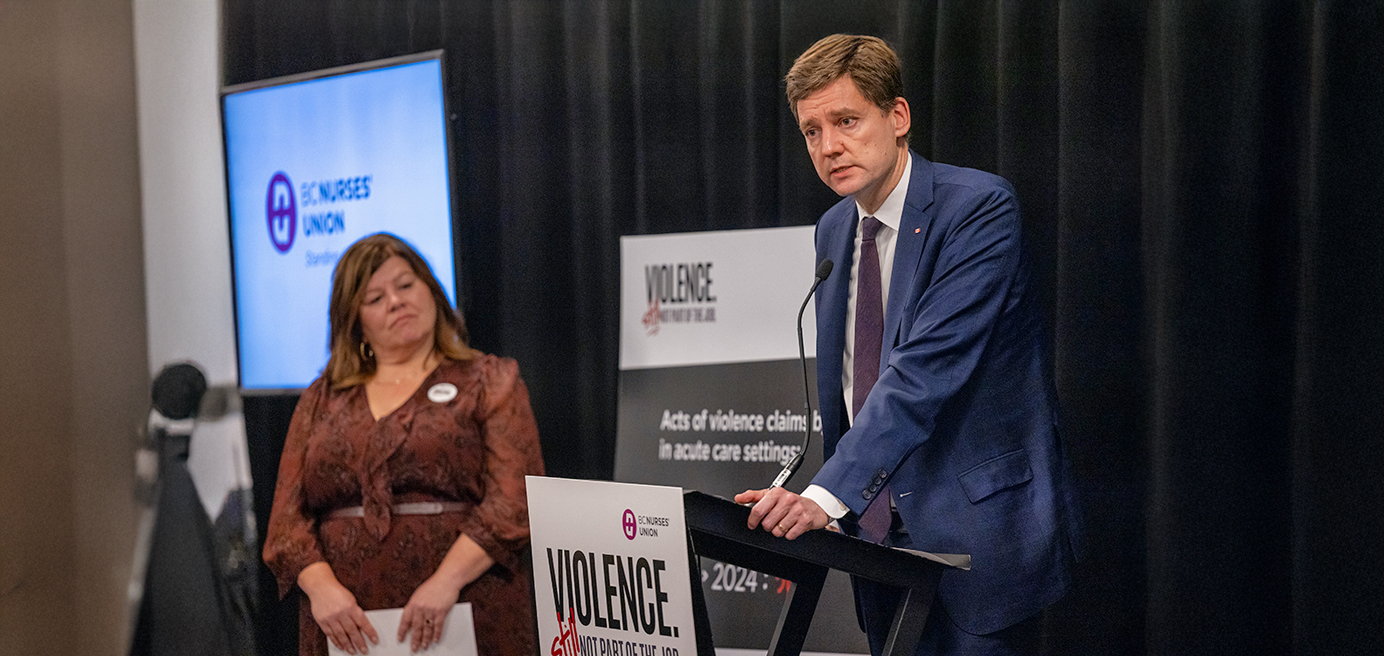
FRONT AND CENTRE BCNU representatives from across BC met with politicians in Victoria to raise concerns about violence against nurses, calling for all-party support to make violence prevention and safe staffing a real priority for health authorities and the government.
When nurses from across the province gathered in Victoria to meet with MLAs this October, they carried a message that could not be ignored: violence in health care is escalating, and the failure to take meaningful action is standing in the way of rebuilding the nursing workforce needed to deliver safe care.
The meetings marked the launch of the BC Nurses’ Union’s new “Violence. Still Not Part of the Job” campaign – a renewed and urgent effort demanding the provincial government and health authorities finally confront the crisis of violence in health-care settings.
“We spent our time in Victoria ensuring every MLA – regardless of their political stripe – acknowledges the reality facing nurses on the front lines,” says BCNU President Adriane Gear. “We expect that all political parties in this province make violence prevention and safe staffing a real priority.”
For Gear, the message is clear: violence in health care is not a new issue – but it is one that has been allowed to worsen.

FACE TIME Green Party leader Emily Lowan attended the event and spoke with BCNU South Fraser Valley regional council member Glesy Banton-Victoria and Central Vancouver regional council member Kristina Hernandez
A Crisis That Hasn’t Gone Away
BCNU first launched its “Violence. Not Part of the Job” campaign in 2017, sparking public awareness about the assaults, threats and abuse nurses face daily. But eight years later, the problem persists – and in many ways, it has worsened.
Across emergency departments, psychiatric units, medical-surgical wards, community settings and long-term care homes, nurses from every designation continue to experience physical attacks, emotional abuse and harassment, most often from patients and visitors. The trauma is taking an enormous human toll on nurses across the province, pushing many out of the profession altogether and worsening the staffing shortages that fuel even more violence.
“Violence leaves lasting scars – physically, emotionally and professionally,” says Gear. “Every act of violence pushes another nurse out of the profession. We cannot continue to accept this as the cost of care.”
The new campaign is building on BCNU’s past advocacy, but with a sharper focus on solutions – and a direct link to the union’s ongoing efforts to implement minimum nurse-to-patient ratios across the province.

BROAD SUPPORT Former Conservative Party leader John Rustad also spoke at the event.
The Violence and Nurse-to-Patient Ratio Connection
Research consistently shows that the root causes of aggression in health care stem from systemic conditions – not from individual patients or workers. The 2020 UBC study ‘Workplace Violence Among British Columbia Nurses Across Different Roles and Contexts,’ found that workplace factors such as inadequate staffing, heavy workload, long wait times and lack of resources were among the leading contributors to patient aggression toward nurses.
Emergency departments, psychiatric units and medical-surgical floors – areas that face high patient volumes and severe staffing shortages – also report high rates of workplace violence. The study found that patients were the primary source of physical and verbal assaults, while threats and emotional abuse often came from both patients and family members.
“The correlation between staffing and violence is undeniable,” says Gear. “When nurses are stretched thin, patients wait longer for care. Frustration builds, tensions rise and aggression becomes more likely,” she explains.
Gear says minimum nurse-to-patient ratios ensure that nurses have the time, capacity and resources to respond promptly, de-escalate early and provide consistent, compassionate care that prevents anger from turning into threats or physical harm. More nurses on the floor means calmer units, fewer delays, safer interactions and better outcomes for everyone – which is why violence prevention cannot be separated from safe staffing.
A growing body of evidence also links heavy workloads to increased incidents of emotional and physical violence from patients and families. Nurses report that when they can’t meet patients’ needs because of unsafe staffing levels, they become the immediate target for anger and fear.
BCNU’s campaign drives home the message that the same conditions making care unsafe for nurses also make it unsafe for patients. “When nurses don’t feel safe, patients aren’t safe either,” says Gear.
Nurses Have Real Solutions
During the campaign launch, BCNU presented MLAs with a set of 10 violence prevention measures for the government and health employers to act on, developed directly from the experiences and expertise of frontline nurses. Together, they call for stronger staffing, safer environments and clear accountability.
At the provincial level, the union is urging government to fully implement minimum nurse-to-patient ratios, establish a standardized provincial model for relational security officers, modernize security infrastructure such as alert systems and weapons detection, strengthen data collection and monitoring and finally fulfill longstanding commitments contained in the 2016 Nurses’ Bargaining Association memorandum of understanding on workplace violence prevention.
For health authorities, the measures focus on the day-to-day realities nurses face: conducting rigorous risk assessments and appropriate patient placement, providing mandatory role-specific training, improving incident reporting and debriefing supports, adopting safer environmental and access-control designs and ensuring leaders are fully accountable for creating and maintaining a culture of safety.
The measures presented underscore the fact that nurses are not only raising the alarm, but putting practical, evidence-informed solutions directly on the table.
“These recommendations reflect not only our members’ lived experiences, but also their professional expertise in building safer workplaces,” says Gear. “Nurses know what the problems are. Nurses also have solutions. It is time to listen to them.”
A Health-Care System Under Pressure
The urgency behind the renewed “Violence. Still Not Part of the Job,” campaign is rooted in a health-care system that is straining under the weight of chronic short staffing, rising patient acuity and unprecedented levels of workplace violence. Nowhere is this pressure more visible than in BC’s emergency departments – often described as ‘pressure cookers’ and a flashpoint for patient frustration, long wait times and volatile behaviour.
Nurses working in these environments describe a landscape where increasing complexity meets dwindling resources: patients waiting hours or even days for beds, patients and their families overwhelmed by uncertainty and staff stretched far beyond safe limits. The result is a combustible mix that places both nurses and patients at risk.
Nurses’ responses to a province-wide BCNU survey conducted last year revealed some startling statistics around the regularity and frequency of workplace incidents, including the experience of physical violence and verbal or emotional abuse and exposure to illicit substances and weapons. On a monthly basis, a staggering 81 percent of nurses reported that they experience verbal and/or emotional abuse, 61 percent said their units are exposed to illicit substances and 39 percent reported being exposed to weapons. Nearly half reported working short-staffed every day and more than a third say they are seriously considering leaving the profession or are already making plans to do so.
The latest Statistics Canada data show BC’s systemic nursing shortage continues with close to 5,000 current vacancies.
BCNU warns that unless staffing levels improve and systemic pressures are urgently addressed – through violence-prevention measures, leadership accountability and the rapid implementation of minimum nurse-to-patient ratios – the system will continue to buckle under the pressure.
“The province cannot hope to retain or recruit the nurses needed to stabilize emergency departments if those workplaces remain unsafe, unpredictable and unsupported,” says Gear. “Our violence campaign makes it clear: protecting nurses is inseparable from protecting patient care, and the status quo is no longer tenable.”

NURSE-LED SOLUTIONS BCNU Vice President Tristan Newby welcomes MLAs to a meet-and-greet session focused on violence prevention in Victoria in October.
What Comes Next
As BCNU continues its renewed fight against violence in health care, members can expect to see much more in the months ahead. The union will be rolling out a dedicated social media campaign featuring nurses’ first-hand accounts – powerful stories that underscore both the human impact of workplace violence and the urgent need for meaningful change.
A broader member awareness campaign is also underway, reinforcing the message that safer working conditions are essential not only for nurses, but for every patient who depends on the system. This advocacy will run in parallel with the work underway to bargain a new NBA collective agreement, where workplace safety remains a central priority.
“We brought the campaign imagery from the current campaign and past campaigns with us to the first day of bargaining to send a clear and unmistakable message that nurses’ calls for safe workplaces are not new, they’re not negotiable and they will not go unheard,” says Gear. “BCNU is committed to keeping this issue at the forefront – and to ensuring that every member has a strong voice in the fight for safer, more respectful and more sustainable health-care environments across the province.”
UPDATE (Winter 2025)
TOP 10 VIOLENCE-PREVENTION MEASURES
BCNU is calling on the provincial government to take action to prevent violence against nurses. Here are the top ten health and safety measures BCNU brought to the MLA meet-and-greet in Victoria
Safety in Numbers: Minimum Nurse-to-Patient Ratios
Fully implement and enforce evidence-based nurse-to-patient ratios pursuant to the BC government’s policy directive in order to reduce patient mortality and mitigate violence risks linked to inadequate staffing levels.
Respect, Respond, Prevent: Expanding and Enhancing Hospital Security
ASK: Relational Security and Trained Safety Personnel
Establish a province-wide approach to the role of relational security officers (RSOs), including a standardized job description and training program. Prioritize prevention-focused presence, early intervention, trauma-informed care and respectful collaboration with health-care teams. Consider the integration of hospital police who possess the appropriate authority to enforce the law within hospital settings.
No More Waiting: Reliable Systems for Real Protection
ASK: Effective Alert Systems and Technological Infrastructure
Ensure fully functional panic buttons, mobile alerts, surveillance, lighting and real-time monitoring. eTechnology should support quick response and integrate with security and care teams. Invest in AI-assisted weapons detection.
Track the Trends, Mitigate Risks
ASK: Data-Driven Improvement and Continuous Monitoring
Track leading and lagging indicators (near misses, code whites, sick time, etc). Use this data to guide quality improvement, policy changes and resource allocation to prevent violence proactively. Include analysis of incidents involving exposure to non-prescribed substances, especially where substance use contributes to aggressive or unpredictable behavior. Identify and adjust risk assessments, PPE guidelines and staff-support protocols accordingly.
Promises Made, Promises Broken
ASK: Fulfillment of the 2016 MOU on Violence Prevention
In 2016, the Ministry of Health committed through a memorandum of understanding with the Nurses’ Bargaining Association to deliver a provincial violence prevention framework, complete with timelines, accountabilities and clear policy direction to health authorities by Dec. 31, 2016. This obligation remains unfulfilled.
Assess the Risk, Place with Purpose
ASK: Comprehensive Risk Assessments, Appropriate Patient Placement and Integrated Care Planning
Standardize violence risk assessments at both facility and unit levels using dynamic and static indicators (e.g. acuity and patient history). Ensure high-risk or behaviorally complex patients are placed in safe, suitable environments with proper staffing and resources. Triage processes must support early identification of violence risk factors. Consideration should be provided to establishing a provincial alert system, linked to individual care cards, to proactively identify and communicate known risks of violence across care settings and health authorities. Enhance care continuity through team-based planning, effective communication and clear handover between departments, units and facilities. Strengthen discharge planning and care transitions to reduce patient frustration and aggression.
Smart Training, Safe Teams
ASK: Mandatory, Role-Specific Violence Prevention Training
Provide ongoing, scenario-based training (in-person and virtual reality-based where possible) for all staff levels – clinical, support and leadership – focusing on early warning signs, de-escalation and trauma-informed responses.
From Incident to Insight: Report, Reflect, Recover
ASK: Incident Reporting, Debriefing and Support Systems
Streamline digital reporting tools, ensure timely debriefings and establish post incident support systems, including psychological first aid, peer support and counselling. Communicate resources clearly and ensure access for impacted workers.
Safe Workplaces Are a Right, Not a Luxury
ASK: Environmental Design, Controlled Access and Patient Search Policies
Improve facility design to support safety, i.e., fewer multi-bed rooms, clear wayfinding, secure intake areas, good lighting and limited access to staff-only areas. Ensure visibility and physical layout reduce risk and support timely response. Incorporate policies regarding weapons and patient searches with input from frontline health-care workers.
Accountability in Action: Building a Culture of Trust and Safety
ASK: Leadership Accountability and Safety Culture
Make workplace safety a leadership priority through clear policies, named safety champions, zero-tolerance policies for violence and visible follow-up on staff-reported concerns. Embed psychological safety and encourage transparency.