

 Defending Medicare
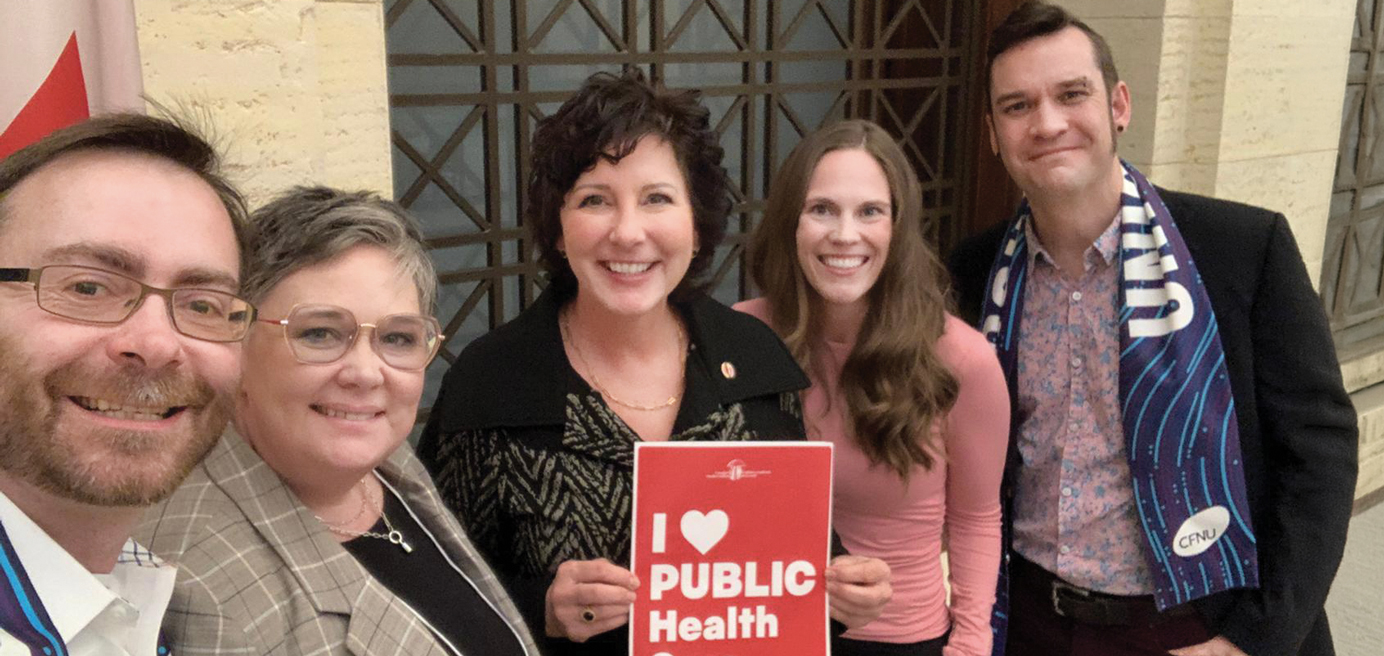
UNIVERSAL ALLIES BCNU Vice President Tristan Newby, United Nurses of Alberta’s Christine Moncrieff, Senator Tracy Muggli, Health Sciences Association of Alberta’s Megan Connolly and BCNU campaigns officer Joel French.
Since Canada enshrined universal health care with the Canada Health Act in 1984, there has never been a shortage of threats to public health care from forces that prioritize profits over people. The latest of these threats comes from the provincial government in Alberta in the form of Bill 11, legislation that is poised to open that province’s doors to U.S.-style private health care.
“There is a national crisis in health care, and it demands bold leadership from the federal government.”
- BCNU President Adriane Gear
The bill would allow physicians to practise in the public and private systems at the same time, introducing a two-tiered model that could see those who can pay skip health-care wait lines. In addition to violating the Canada Health Act’s core principles of universality and accessibility, the bill threatens to open Canada’s health sector up to American investors, tilting the scale towards the for-profit model.
Concern over Bill 11 was among the core issues the Canadian Health Coalition (CHC) raised with politicians of all political stripes in Ottawa at its Parliament Hill lobby day in February.

The CHC brings together health-care workers, seniors, anti-poverty and women’s groups, trade unions and provincial and territorial health coalitions from across the country. The coalition is sounding the alarm bell about the dangers of the Alberta legislation, which could derail universal health care in the rest of Canada. In total, over 200 people from every province and territory joined the CHC delegation, and they met with more than 100 elected Members of Parliament and Senators.
BCNU participates in the CHC through the Canadian Federation of Nurses Unions (CFNU), and BCNU Vice President Tristan Newby serves in elected positions of both bodies, helping to guide their work.
“The momentum for privatization we’re seeing in Alberta should be concerning to everyone across the country who values public health care,” says Newby. “American private insurance companies are out to make massive profits off Canadian health care like they do in the United States, and once they get their foot in the door, it will be next to impossible to get them out. The federal government has a responsibility through the Canada Health Act to defend our health-care system, and we need them to step up in a big way to do that now.”
“American private health insurance companies are out to make massive profits off Canadian health care”
- BCNU Vice President Tristan Newby
The Canadian Centre for Policy Alternatives, a progressive think tank that researches public policy, recently published a report on Bill 11 in partnership with Alberta’s Parkland Institute, co-written by health-care researchers Andrew Longhurst from BC and Rebecca Graff-McRae from Alberta. According to the report, “Bill 11 establishes two-tier health care, which is defined as a system that provides faster access to those with the ability to pay privately, and longer public wait times for those who are unable to pay for queue jumping.”
It warns of many dangers in the legislation, including higher overall health-care costs, longer public wait times and the possibility of user fees being introduced. Worryingly, Bill 11 also opens the door to for-profit hospitals in Canada and a future where American health insurance companies become established in Canada and then entrenched through trade and investment agreements between the two countries. The CHC launched a campaign at www.healthcoalition.ca urging federal Health Minister Marjorie Michel to enforce the Canada Health Act, which guarantees medically necessary care based on need, not ability to pay.
Canada’s Nurses Take Demands to Ottawa
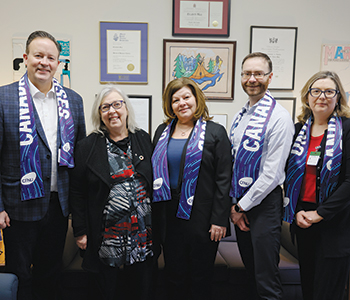
CFNU recently held a national lobby day of its own in Ottawa, raising similar concerns about the federal government protecting public health care from privatization, as well as issues related to violence prevention, the nursing shortage crisis, minimum nurse-to-patient ratios and Indigenous health. While provincial governments play the lead role in providing health care to most of the population, the problems in these areas are similar across the country, making it critical that all levels of government step up in any way they can.
“Communities across Canada are facing nurse staffing shortages, violence against health-care workers and privatization threats to the public health-care system,” says BCNU president Adriane Gear, who also sits on the CFNU executive board. “That’s why nurses from across the country joined together in Ottawa – to tell Members of Parliament that these are not localized issues. There is a national crisis in health care, and it demands bold leadership from the federal government.”
“When joining with other health-care workers, nurses can be the powerful force this country needs to ensure everyone has access to the care they need.”
- BCNU Vice President Tristan Newby
The union’s participation in coalitions like the CHC and CFNU has been on the rise in recent years. BCNU’s leadership on minimum nurse-to-patient ratios has made the union a valuable resource to other provinces looking for effective ways to improve nurse retention and patient safety. Given the seriousness of the challenges public health care in Canada is facing, BCNU CEO Jim Gould, who also attended the CFNU lobby day, says that presenting a united front to governments couldn’t come at a more crucial time.
“The federal and provincial governments play such important roles related to nurses’ ability to provide high-quality care to patients,” says Gould. “If public health care isn’t a high priority for both, our members’ jobs become even more difficult. Federal leadership is part of what unifies us as a country around the principle that every person deserves access to health care – it shouldn’t depend on whether you can afford to pay.”
Because the principles of universality and accessibility are embedded in the Canada Health Act, the federal government has leverage it can use to prevent provinces from opening their health-care systems to private insurance markets for medically necessary care. Whether it chooses to do so rests with government leaders, particularly Prime Minister Mark Carney and Health Minister Marjorie Michel.
“The stakes are nothing less than the existence of public health care in Canada,” warns Newby. “When joining with other health-care workers and allies, nurses can be the powerful force this country needs to ensure everyone has access to the care they need when they need it. It is up to the federal government to step up and do the right thing – keep our health-care system focused on people, not profits.” •
UPDATE (Spring 2026)