
 My Journey: Adeline Vinola
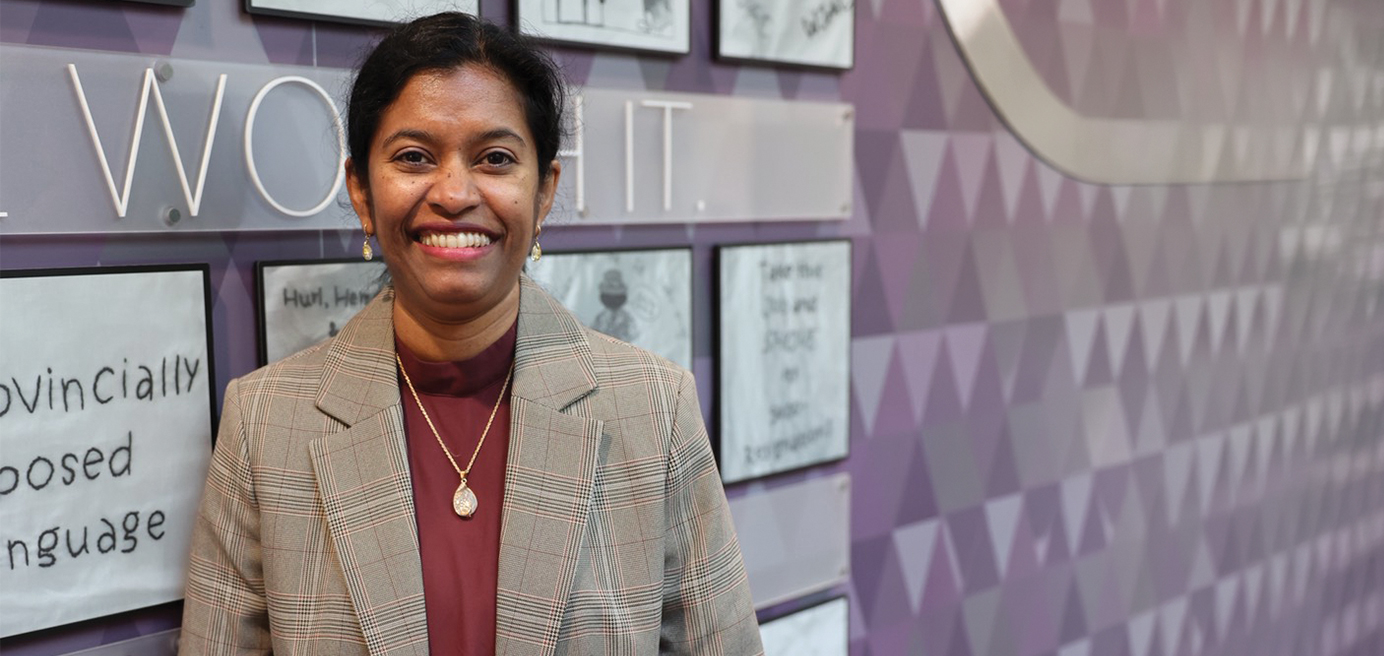
ACROSS BORDERS Internationally educated nurses like Adeline Vinola bring broad experience that Canada’s credentialling system renders invisible.
Nursing, for Adeline Vinola, begins with tender childhood memories in Tamil Nadu, India, where she used to accompany her aunt to hospitals and watch her care for patients as a nurse. She remembers feeling eager as a child, wanting to be “strong enough” one day to care for patients too. This sense of purpose and connection to nursing has carried Vinola as she pursued nursing education and practice around the world.
Tending to Webs of Care
As a registered nurse for nearly 23 years, Vinola has built a career spanning three continents. She is a proud graduate of one of the most renowned health-care institutions in India, Christian Medical College in Vellore, where she also began her nursing career specializing in community nursing and medical surgical units. After three years, she relocated to Abu Dhabi. There, over the span of 14 years, Vinola progressed from working as a bedside nurse to becoming a leader in nursing education and simulation – all while also beginning her journey as a mother. With the onset of the COVID-19 pandemic in 2020, Vinola wanted a more stable future for her children and made the difficult decision to move to the UK.
In the UK, Vinola started her career again as a nurse for Manchester University’s NHS Foundation Trust, where she began at the bedside and later became a clinical research nurse, leading clinical trials and facilitating simulation drills. In the pursuit of a better future for her family, in 2023 Vinola attended an information event about becoming a registered nurse in British Columbia organized by Health Match BC.
For Vinola, starting over was a risk worth taking.
“I was thinking a lot about my age, like, is this appropriate for me to move to a different country at this age? Taking all the challenges?”
“But then I said, no, I’m going to move forward.”
Beyond professional barriers, moving countries with her family made Vinola’s transition more challenging.
“It was a challenging phase for me and for my kids because my kids’ schooling was completely different,” she says.
After moving to Canada, she was balancing orientation training, competency preparation, finding housing, supporting her children with school enrollment and her husband with finding employment.
“It was a big challenge for all of us as a family.”
For many, the journey of nursing abroad is often one that families take together. The decision to practise nursing globally is one that internationally educated nurses (IENs) make with, and in support of, their families. These relationships are lifelines for IENs’ well-being. In designing supports for these nurses, health-care organizations should also consider their relationships, who they support and are supported by, both in their countries of origin, and those that migrate with them to Canada.
Beyond Borders
When Vinola moved to Vancouver in March 2024, despite her extensive work experience, the journey to become licensed and registered to practise in Canada still brought unique challenges.
“I have mixed feelings,” she says.
She felt confident, but also nervous with the “fear of starting in a new country” and “not knowing enough about how nursing is practiced in an unfamiliar health-care system.” For IENs, each migration comes with the struggle of proving competency, navigating unfamiliar systems, rebuilding professional confidence and learning how to advocate for themselves in new environments, often many times over.
“The first thing that I want to say to every IEN is: you’re not alone.”
- Adeline Vinola
Globally, nursing is a profession composed of multiple traditions, clinical cultures and ways of knowing. Competence for IENs is cultivated through practicing in many different contexts rather than along one prescribed route based on where they obtained their nursing education. For both IENs and Canadian-trained nurses, parts of the journey may occur in different locations, but for the internationally educated, those locations stretch across borders and longer spans of time.
For Vinola, one of the biggest adjustments was learning to feel confident in speaking up, asking questions and expressing her professional judgment.
Migrating from the UK, her transition to practising as a nurse in Canada was expedited but still required self-advocacy. The competency assessment to become licensed and registered in Canada overlooked Vinola’s experience practicing nursing in English both in the UK and in the UAE.
She was disheartened by the responses that her nursing education in India was not “comparable” to Canadian standards of nursing and that she had to first complete the computer-based exam and travel to BC to complete the simulation exam to prove competency.
Nervous about the cost and uncertainty of this process, Vinola advocated for herself, contesting the decision on the registration pathway she had been assigned.
“The minute they saw my email, my file was immediately transferred to the BC College of Nurses and Midwives. And then overnight, I got a decision saying that I got a provisional registration.”
Vinola argues that for IENs, competency assessments should “consider their experience and the country where they are currently working, because that helps them a lot. You’re looking only into the education, but after completing their education, they may be working elsewhere.”
Her path illustrates how the complexity of global nursing careers does not neatly fit into the existing limits of registration pathways in BC.
She believes more recognition of nurses’ professional mobility could reduce unnecessary barriers for internationally trained professionals who have gained experience in multiple health-care systems.
The careers of IENs are marked by continual learning and reinvention, requiring resilience, flexibility and the ability to build trust in new teams and communities while carrying forward the responsibilities of caregiving in their professional and personal lives. What distinguishes their journey from that of many Canadian-educated nurses is not the quality of their education, but the dynamic nature of their experience. IENs’ nursing career trajectories are shaped by travelling through transnational health-care systems and cultures, fostering an understanding that there is no single “correct” way to become a nurse or to practise nursing. They continuously embody cultural humility through a global vision of the profession which recognizes that multiple worlds of nursing knowledge and practice co-exist, each rooted in its own social, cultural and institutional context.
It takes a village
Having been in Canada for more than two years now, Vinola notes that she feels empowered working as a registered nurse at Vancouver General Hospital’s leukemia bone marrow transplant unit.
“Even with 20 years of experience, starting in a new specialty, in a new country, getting adjusted to the new health-care routine – I was kind of scared,” she says.
“Like, you feel something is right, but are you confident enough to express that? That took a while for me.”
Vinola built that confidence through nurturing relationships at work. Her experience highlights a point raised in a Canadian Federation of Nurses Unions 2025 report, Bolstering Pathways to Practice: Empowering Internationally Educated Nurses in Canada. According to the report, successful integration of IENs requires wrap-around supports. Integration requires mentorship, orientation and opportunities for nurses to build confidence in Canadian health-care settings.
“The main form of support that I experienced here is BCNU,” Vinola says. “I’m so thankful because I have not seen such a strong union in my professional life.”
“In terms of fighting for our rights, expressing what we feel is right, attending workshops, getting yourself updated, having separate workshops for IENs, having stewards in your hospital and having representatives coming and checking in on you – with these kinds of support, I feel like BCNU is doing a great job.”
She also credits IEN nurse educators at her hospital for helping her feel comfortable and safe in asking questions about both clinical expectations and cultural aspects of nursing that cannot be standardized. They affirmed to Vinola that asking questions was not a sign of incompetency, but rather an expected aspect of nursing education, especially where nurses are learning to practise in new specialties.
“They provided me with all the information about the workshops that I could attend, where I learned the nursing routine in Canada, what I can do, what I cannot do, what I need to follow, where I have to refer to and if I have concerns, how do I escalate that.”
Giving Back to Be the Change
Despite the challenges, Vinola says the support she received helped transform the experience from overwhelming to achievable. She now offers that same support to other IENs by speaking at workshops, discussing her experiences and reminding newcomers that their struggles are shared.
Vinola offers a simple message to all new IENs.
“The first thing that I want to say to every IEN is: you’re not alone. There have been many people before you, and there are many people waiting after you. And you are going to be an inspiration.”
She acknowledges that the process can be difficult but persistence matters.
“Please do not give up. This is achievable. Although the road is hard, please remember that you are going to have a great impact in your environment, and you’re bringing hope to the people around you. It’s not easy, but it’s worth it.”
UPDATE (Summer / Fall 2026)