

 Building on Experience
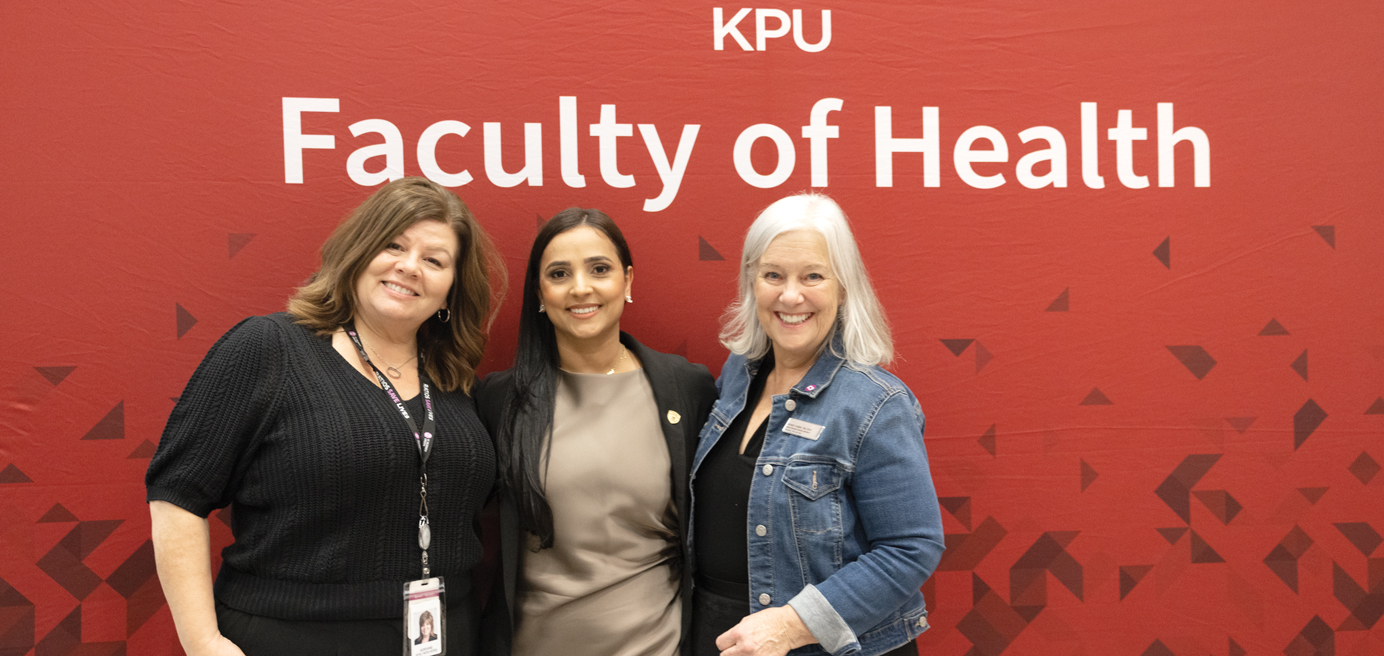
THE GRADUATE BCNU President Adriane Gear stands with Aman Thoor and BCNU Simon Fraser regional council member Wendy Gibbs.
Nearly twenty Licensed Practical Nurses (LPNs) at Royal Columbian Hospital (RCH) are one step closer to becoming Registered Nurses (RNs), thanks to an innovative program designed to support career mobility for experienced nurses while filling critical staffing shortages in BC’s health-care system.
The graduates are the first cohort of the LPN Learn to Earn program, a partnership between Kwantlen Polytechnic University (KPU), Fraser Health and BCNU. Launched in 2024, the program provides experienced LPNs with a streamlined pathway to earn their bachelor of science in nursing (BSN) while continuing to work in the public health system.
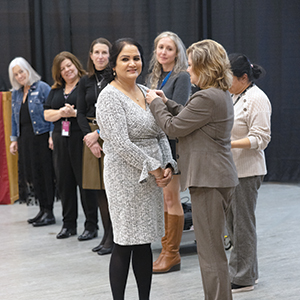
At a traditional BSN pinning ceremony at KPU’s Langley campus on Nov. 27, the cohort was jubilant, celebrating their commencement surrounded by friends, family, instructors – and their union.
“We are incredibly proud of these members and congratulate them on their achievement,” said BCNU President Adriane Gear, who attended the pinning ceremony alongside BCNU Simon Fraser regional council member Wendy Gibbs. “Their hard work and determination in completing this program will advance their careers while helping to bring us closer to minimum nurse-to-patient ratios.”
Partnership Helps Ease the Transition into Schooling
What sets the LPN Learn to Earn program apart is its integrated employment-and-education model. Program participants keep their jobs at Fraser Health and work part-time while studying full-time at KPU. This allows students to retain not only their income, but also their benefits and seniority under the collective agreement rather than starting over once they graduate. The model promotes internal career growth, addresses persistent RN shortages – particularly in acute care settings – and helps stabilize the workforce.
That focus on retention was central to the program’s design, according to Gibbs, who helped develop and implement the initiative.
“This experience really reignited my passion for nursing.”
- Aman Thoor
“LPN Learn to Earn grew out of professional practice at Fraser Health,” Gibbs says. “It was about finding an agreement that could keep some LPNs working, get them to school and bring more RNs into the system.”
The program also provides financial support through BCNU’s LPN Laddering Fund. The $20 million fund, negotiated with the BC government, supports LPN members pursuing RN or RPN designation by helping offset tuition, books and related costs, reducing the financial strain of returning to school.
“The fund was key to helping these students finish their program” Gibbs notes. “Along with staying job-attached, the financial support eases the pressure of going back to school – especially for established LPNs.
Gibbs adds that upgrading can be especially stressful for people already in the workforce. “Most LPNs going to school like this have families and mortgages,” she notes. “That makes going back to school difficult.”
Alongside funding and job retention, BCNU also provided these members with advocacy and practical support. Gibbs, along with the BCNU labour relations team, helped ensure that participants’ rights under the collective agreement were protected – while also creating flexibility where needed.
“My role was to make sure the collective agreement was followed,” she remarked. “We negotiated a memorandum of understanding that created a formal agreement with the employer. That kept everything straightforward for the students while they studied and when they completed the program.”
Program Helps Experienced Nurses Expand their Skillset
For Aman Thoor – the pinning ceremony marked the fulfillment of a long-held professional goal. Thoor has spent more than a decade working in acute care and had completed prerequisites to begin her BSN studies years earlier. But, like many LPNs, she faced long waitlists and limited program availability.
A working parent, Thoor appreciated the program’s flexibility, which allowed her to balance family responsibilities alongside work and full-time studies.
“These members’ hard work and determination will advance their careers while helping implement minimum nurse-to-patient ratios.”
- BCNU President Adriane Gear
“I began the program just three months after giving birth to my daughter, which was overwhelming at times,” Thoor remarked. “But I was fortunate to have an instructor who helped me feel supported and capable. This program truly understands the demands of nursing, while offering compassion, flexibility and the kind of teaching that builds confidence and purpose.”
Balancing parenthood, work and full-time studying was demanding, Thoor reflects, but the program’s structure made it feasible in ways traditional nursing pathways often are not.
“This experience really reignited my passion for nursing,” she says.
Thoor also emphasized that the program recognizes the value of prior experience and respects LPNs expertise, rather than treating participants as entry-level students.
“LPNs come with hands-on experience at the bedside,” Thoor notes, “That experience supports patient care, especially in complex areas of practice where more clinical judgment really matters.”
Looking ahead, Thoor is eager to use her advanced skillset to take on more complicated assignments. After all, the opportunity to expand her scope of practice and operate more independently is what motivated Thoor to enter the program in the first place.
“As RNs, we’re prepared to take on more complex decision-making and broader responsibility,” she says.
She believes the program also strengthens workforce stability across BC’s health-care system.
“This program helps keep nurses working,” Thoor explains. “Health-care employers aren’t losing staff when people choose to study.”
Retaining nurses in the workforce is a critical step in implementing and maintaining minimum nurse-to-patient ratios. That’s why BCNU negotiated $68 million in training and licensing funding with the BC government – an investment that made the LPN Learn to Earn program possible.
“Helping LPNs attain their BSN helps fulfill ratios in the future,” Thoor adds. “It increases the number of nurses at the bedside while retaining experienced staff.”
Gibbs describes the program as a win-win for both employers, students and the public.
“Over time, investing in these nurses saves money and helps stabilize staffing.”
Learn to Earn Program Expands
Following the pilot program’s success at RCH, KPU has already begun expanding the program: cohorts two and three are now underway at five Kwantlen campuses throughout the lower mainland.
The graduates also continue to expand their knowledge after completing the program. “As RNs, you have many opportunities to specialize,” says Thoor. “That’s a huge benefit to a health-care system with increasingly complex and diverse care needs,”
At the same time, many nurses continue to choose LPN roles, providing the essential hands-on care they are trained to deliver. Others see value in expanding their scope of practice as RNs and helping to fill shortages in specialized areas.
“The costs of schooling – both tuition and lost income – slow down a lot of nurses who might otherwise pursue further training,” says Gibbs. “This program helps bridge that gap.”
As many members of the first cohort move towards RN licensure, the program’s early outcomes point to a promising model for strengthening the workforce without temporarily losing experienced clinicians. By recognizing prior experience, supporting nurses financially and keeping them embedded in their workplaces, the LPN Learn to Earn program offers a pathway that benefits nurses, employers and patients alike.
For Thoor, the impact is both professional and personal. “Now we’re stepping into a new role without delay. That makes a difference – not just for us, but for the care our patients receive.” •
UPDATE (Spring 2026)