
 Nurses Speak Out
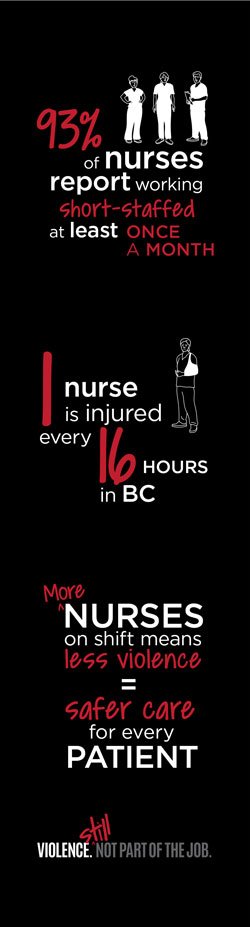
Violence against nurses has not faded into the background. In fact, it has intensified – becoming more frequent, more severe and disturbingly normalized in health-care workplaces stretched thin by chronic understaffing and rising patient acuity.
That refusal is at the heart of BCNU’s Violence. Still Not Part of the Job. campaign. Through a series of short videos shared across BCNU’s social media channels, members from acute care, long-term care and community care speak directly about what violence looks like in their workplaces – and what would prevent it.
“Violence doesn’t happen in a vacuum. It grows in environments where nurses are stretched too thin and supports aren’t there when they’re needed”
- BCNU President Adriane Gear
In the videos, the nurses explain how desperately needed safety measures would protect them on the job. They speak about how well-trained, consistently present relational security officers could not just respond to incidents – but prevent them. They describe how safe staffing and nurse-to-patient ratios would allow them to anticipate risk and create calmer, safer environments for patients and staff alike. Others highlight the role of risk assessments, safer workplace infrastructure and design and leadership accountability in preventing situations from spiraling into harm.
BCNU has been sharing these safety measures with decision-makers since October 2025, when the union met with MLAs in Victoria to present ten violence prevention measures – five for government to act on and five for health authorities to implement. The measures focus on strong staffing, safer environments, early intervention and clear leadership responsibility – practical ideas developed directly from frontline nurses’ expertise.
“These are achievable measures that not only reflect our members’ lived experiences, but also their professional expertise in building safer workplaces,” says BCNU President Adriane Gear. “Violence doesn’t happen in a vacuum. It grows in environments where nurses are stretched too thin and supports aren’t there when they’re needed.”
The videos underscore a reality BCNU members know well: violence in health care is not inevitable. It is shaped by systems – and systems can be changed.
Insights From the Front Lines
BCNU members spoke out about their experiences with violence in the workplace – and the measures that would keep them safe.
Jennifer
Bridgette
Tash
Melissa
Gerrie
Prevention Requires Systems that Work
While BCNU continues to call on health authorities to implement the five violence prevention measures, prevention is only part of the equation. Because prevention cannot succeed without systems that capture what is happening on the ground.
That is where reporting comes in.
BCNU consistently hears from members about violent incidents that are never fully captured in the employer’s reporting systems. Sometimes reports are delayed. Sometimes they are incomplete. Sometimes they never happen at all – not because nurses do not care about safety, but because reporting systems don’t reflect the realities of nursing work.
Members describe trying to report incidents mid-shift with no time for or space for privacy. At the end of an exhausting day, members sometimes postpone or forget to report. Night shift nurses miss call-backs while sleeping. Early injuries or exposures are brushed off, only to worsen later with no clear paper trail.
“Reporting is how experiences become evidence,” says Gear. “It’s what allows for investigations, corrective action and employers to be held accountable. Without it, even strong violence prevention policies are difficult to enforce.”
At the same time, reporting systems have failed to take advantage of modern technology. Phone-based systems with limited hours and delayed call-backs may not align with shift work, confidentiality needs, or workload pressures. Worse, many nurses still feel pressure to “tough it out” when they’ve experienced a violent incident or have become desensitized after years of not being heard.
“Reporting isn’t complaining,” says Gear. “It’s using your voice to protect yourself, your colleagues and the nurse coming on after your shift. It’s about making sure the system can’t ignore what’s happening.”
Looking Ahead
In the months ahead, BCNU is emphasizing awareness and action with a new campaign encouraging members to report violent incidents and near-misses. The campaign reinforces the importance of reporting as a core pillar of violence prevention and a concrete measure to ensure employers do not delay or deflect action.
And while we know reporting is effective, safer workplaces require more than individual effort. That’s why BCNU continues to pressure health employers and the government to fully implement the violence prevention measures already on the table – and to foster environments where reporting is supported, accessible, encouraged and acted upon. Because violence is still not part of the job. And neither is silence.
At the same time, BCNU is engaging members and the public in a province-wide letter writing effort to call on their MLA to implement five key safety measures and pressure health authorities to protect nurses and patients.
The effort marks a new phase of advocacy – one that invites decision makers to play a direct role in demanding safer health-care workplaces. By opening the campaign to patients, families and the broader public, BCNU is amplifying frontline voices and reinforcing that violence in health care is not only a workplace issue, but a concern that affects everyone who relies on the health-care system.
As the campaign evolves, one thing remains constant: nurses are leading the way, using their voices, their expertise and their collective power to demand the safe, respectful working environments they deserve. •
Speak Up for Safety
Join BCNU’s letter-writing campaign calling on the BC government to implement five key measures to keep nurses safe.
UPDATE (Spring 2026)