
 2026 Provincial Election
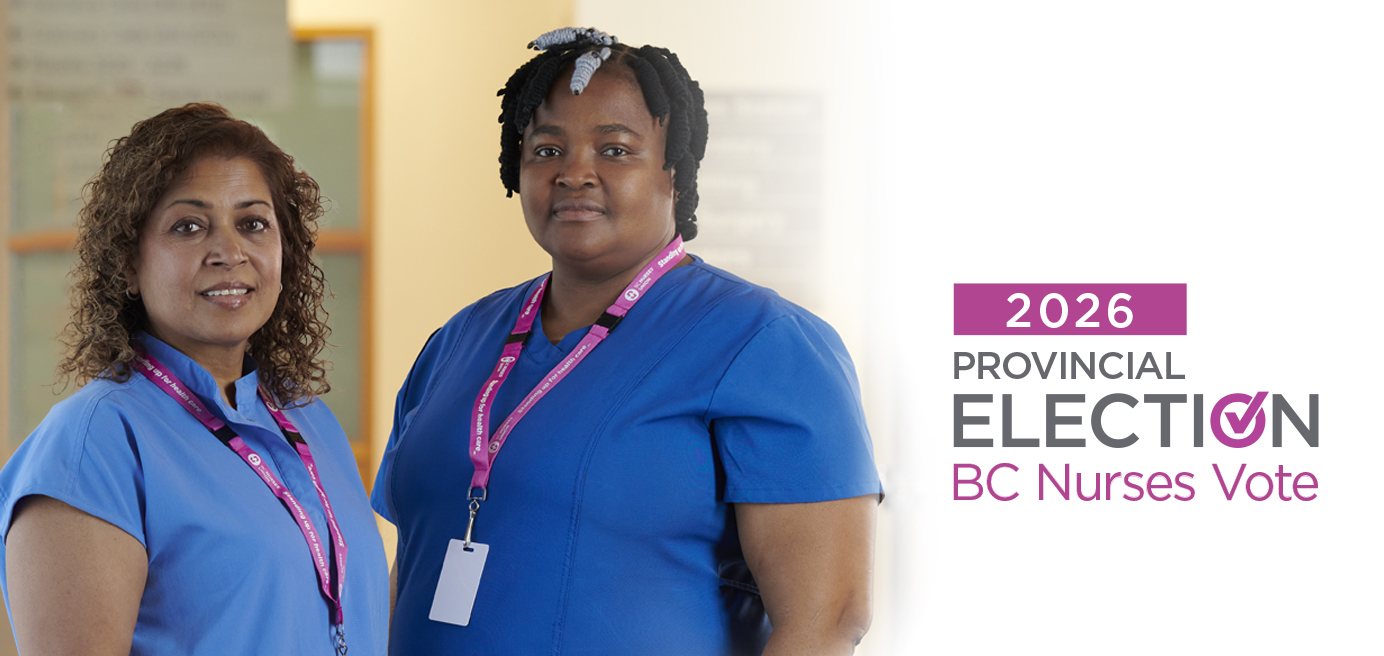
Nurses know staffing shortages have put BC’s health-care system under immense strain.
Minimum nurse-to-patient ratios are a proven solution that will improve health care for nurses and patients. Evidence shows ratios also reduce preventable harm to patients and result in savings of more than twice the cost of the additional nurse staffing.
BC is the first province in Canada to establish minimum nurse-to-patient ratios. Significant progress has been made, and implementation is taking place across the province. Implementation in emergency rooms is next and will help prevent the temporary ER closures experienced by communities across BC. There is still much work to be done, and British Columbians cannot afford to wait any longer than necessary for full implementation of ratios.
Government can support ratio implementation by:
- Reducing the province’s current reliance on expensive private agency nursing
- Continuing to invest in nurse retention and recruitment
- Taking action to address workplace violence
BCNU encourages members and the public to use the Questions for Candidates resource at election-related events, such as all-candidates debates, to highlight the need for government action on these key issues.
This election, vote for a candidate who is committed to making public health care better.
Questions to Party Leaders
BCNU sent the leaders of the BC NDP, BC Conservatives, BC Greens, CentreBC and OneBC questions related to five key issues. Their responses are published below as they are received.
Do you support nurses' call to fully implement minimum nurse-to-patient ratios across all care settings in BC?
CentreBC:
Yes. Minimum nurse-to-patient ratios are about safety, for patients and for nurses. Ratios only work if there are enough nurses to meet them, so our plan builds the workforce to back them up. Retention comes first: better working conditions and full scope of practice. Then more nurses: 300 more nursing seats a year and 600 more nurse practitioner positions in the public system by 2030, with nurses from other provinces, the U.S., the U.K. and Australia licensed within 30 days. Float pools in every health authority will cut overtime. And when we find savings elsewhere in the system, front-line nursing roles are protected.
BC NDP:
Under David Eby, BC was the first jurisdiction in Canada to roll out minimum nurse-to-patient ratios. We did this because it was the right thing to do – to improve the delivery of patient care, provide better working conditions for nurses and support a stronger health sector. More than 85 per cent of the first wave of ratios are now activated in BC hospitals, and we are already seeing positive results for recruitment and retention. Since we started implementing ratios, the number of nurses working in BC has increased by over 4,700.
We know there is more work to do. The BC NDP is committed to continuing the work to implement minimum nurse-to-patient ratios. That’s why we recently committed significant additional funding to the health authorities to further expand implementation of ratios across the province.
Interim BC Conservative leader Lorne Doerkson has not said where he stands on minimum nurse-to-patient ratios. Expanding access to health care takes sustained investment, but the BC Conservatives’ fiscal plan has a $5 billion gap, leaving major questions about how they would balance their promises with the cost of delivering public services. The Conservatives have indicated health care would “bear the brunt” of spending cuts, raising further questions about whether patients would continue to receive care based on medical need or whether the ability to pay would play a greater role.
BC Green Party:
Yes. We will finish implementing minimum nurse-to-patient ratios across all care settings in British Columbia, working in partnership with nurses and their union to make those ratios a reality.
Minimum ratios are essential to patient safety, quality of care and the retention of nurses. They help ensure nurses have the time to assess patients, respond to changing conditions and provide the care people deserve. Establishing ratios is an important first step, but they must be backed by enough nurses to meet them in practice.
The BC Greens’ 2026 platform explicitly commits to finishing the implementation of safe nurse-to-patient ratios. We will work with health authorities and frontline nurses to identify staffing gaps, establish clear implementation milestones and publicly report progress. This must include hospitals, emergency departments, long-term care, assisted living and community care.
We will pair implementation with long-term investments in recruitment and retention, so ratios are not simply a policy on paper but a standard patients and nurses can count on in every region of BC.
What changes will you push for to ensure nurses and other health-care workers are provided with safe workplaces to care for their patients?
CentreBC:
We will put trained protection officers in every emergency department and extend them to rural hospitals and community sites. No one should be assaulted for showing up to care for others. At the highest-risk sites, officers will have peace officer status and work alongside relational security officers trained to calm situations before they turn violent. Every violent incident will be reported and tracked, and the numbers will be published by facility every quarter. Family doctors and nurse practitioners will be able to diagnose psychological injuries for WorkSafeBC claims, and counselling will start within 90 days. We will also cut sick time and injuries among health workers through violence prevention and early return-to-work support.
BC NDP:
Violence has absolutely no place in any workplace. Ensuring hospitals and health-care facilities are safe for staff and patients is a top priority for the BC NDP. That’s why we worked with the BCNU to implement a new security model at hospitals and hired 781 Relational Security Officers across 32 hospitals. RSOs are highly trained; they know how to anticipate, de-escalate and ultimately prevent aggression.
We know that we have more work to do. If re-elected, the BC NDP will take further action to protect nurses in the workplace. This includes:
- strengthening Joint Occupational Health and Safety Committee governance, information access and accountability;
- implementing a pilot project to deploy and evaluate AI weapons detection systems at hospital sites;
- establishing clearer prevention and control requirements for hazardous substances and workplace violence;
- providing stronger immediate supports following traumatic incidents;
- deepening implementation of the CSA Psychological Health and Safety Standard;
- introducing trauma-informed protections for employees affected by sexual or domestic violence; and
- improving disability management, accommodation, mental-health benefits and mechanisms for nurses to raise practice and safety concerns.
BC Green Party:
We will make workplace safety a fundamental responsibility of government and health authorities, not something nurses are expected to manage on their own. BC Greens were proud to stand with the nurses’ union in your 2026 strike to improve working conditions and ensure safe workplaces, and that commitment remains.
A BC Green government will:
- address the causes of unsafe workloads. Fully implement nurse-to-patient ratios, improve staffing plans and ensure nurses have the resources and support required to deliver safe care.
- support workers experiencing physical and psychological harm. Strengthen access to timely mental-health support, appropriate recovery and return-to-work programs, and a workplace culture where reporting safety concerns is encouraged rather than penalized.
- make health-care workers partners in decisions. Ensure nurses, other frontline staff and their representatives have a meaningful role in workplace safety planning and evaluating whether interventions are working.
What will you do to ensure health authorities retain and recruit the nurses BC needs to provide safe care to every patient?
CentreBC:
Keep the nurses we have, then recruit. On retention: better working conditions, full scope of practice, and float pools in every health authority to reduce overtime. Violence prevention and early return-to-work support will cut injuries and sick time. The rural retention bonus becomes permanent and extends to every community with repeated ER closures. On recruitment: 300 more nursing seats a year, 600 more nurse practitioner positions by 2030, and 30-day licensing for nurses from other provinces, the US, the UK and Australia. We will add surgical capacity as operating-room nurses and anesthesia staff are hired, not before. And we will find money for the front line by cutting management. The back offices of every health authority merge into one and senior executive positions are cut in half. Every health authority gets public targets in its mandate letter, with CEO pay tied to meeting them.
BC NDP:
BC’s nursing workforce is growing fast, now totalling nearly 78,000 people with 3,000+ licensing applications currently being processed. Every one of these nurses deserves a workplace that is safe and resourced to meet the increasingly complex health-care needs of British Columbians.
BC’s Health and Human Resources Strategy aims to recruit, retain and train more health-care workers while enhancing the health system to work better for everybody. Of the 70 actions outlined in this strategy, 53 have been completed or are underway, including adopting and implementing minimum nurse-to-patient ratios. BC is the first jurisdiction in Canada to do so.
To build on this progress, if re-elected, the BC NDP will train more health-care workers and add 1,000 new training seats across our public post-secondary system for nurses, nurse practitioners, allied health workers and care aides. Given how critical they are for the system, this will include a 20 percent increase in the number of nursing seats.
We will also triple the size of our U.S. Recruitment Campaign that has already seen over 800 health professionals accept jobs in the province. The new campaign will expand into Republican-controlled “red” states where doctors and nurses are facing laws that restrict their ability to provide life-saving reproductive care. It will highlight a clear alternative: a publicly funded health-care system where professionals can focus on caring for patients, not fighting with insurance companies in a private, for-profit system that can leave people facing catastrophic debt. Recruiters will also focus on areas where workers are most needed, including cancer care, emergency departments and rural communities.
BC Green Party:
While the focus on recruitment of nurses is welcome, retaining the nurses already working in the system would be the biggest priority for the BC Greens. Our platform includes a commitment to adopt and implement the Nursing Retention Toolkit: Improving the Working Lives of Nurses in Canada, with health authorities accountable for meaningful improvements in nurses’ working conditions.
We will also develop recruitment and retention approaches that reflect local needs, including practical supports for nurses working in communities where vacancies and service disruptions are persistent, and build team-based community care centres in every region, allowing nurses to work to their full scope of practice as part of a team.
We will measure success not simply by the number of positions announced or filled, but by whether nurses stay, whether staffing improves and whether patients can reliably access care close to home.
What will you do to reduce health authorities' use of private nursing agencies?
CentreBC:
Phase them out. Outside remote areas, private agency nurses will be replaced by internal float pools in every health authority, so nurses work for the public system, not for agencies charging premium rates. The float pools also reduce overtime. This is part of about $400 million a year in health savings by 2030/31 that help pay for the plan, and front-line positions are protected throughout. It only lasts if nurses want to stay in the public system. That is why the retention measures above come with it: better working conditions, full scope of practice and 300 more nursing seats a year.
BC NDP:
Private agency nurses can be as much as twice the cost per hour as a regular, unionized nurse. We know that the health authorities have become too reliant on agency nurses to fill short-term gaps.
The BC NDP will phase out the use of private agency nurses over the next three years by:
- capping the fees that for-profit nursing agencies can charge
- restricting the number of hours that individual hospital sites can rely on agency nurses – with targets that become more stringent until agency nursing is eliminated; and
- prohibiting agency nurses from working at hospitals where they were previously employed in the last six months
We will also redirect the savings from eliminating the use of private agency nurses to expand the successful GoHealthBC program that supports nurses to serve in rural and remote communities facing ER closures.
BC Green Party:
The BC Greens 2026 platform includes a commitment to phase out reliance on private agency nurses and for-profit staffing agencies, by investing in a stable, directly employed public nursing workforce. Dependence on private agencies diverts public funds into premium staffing costs rather than building the permanent workforce that BC needs.
The retention initiatives mentioned above are part of our plan to improve nursing capacity within the public sector. Our hope is that by improving working conditions, addressing unsafe workloads, supporting professional development and fully implementing safe staffing levels, we can strengthen the internal staffing pool within health authorities so nurses can fill vacancies and cover absences internally.
Will you commit to rejecting privatization and strengthening public health care?
CentreBC:
Yes. Our plan is public health care, not private pay. We will not allow private-pay options that pull doctors and resources out of the public system, and no Alberta-style dual practice. Patients will no longer pay privately for essential primary care, and the private-pay route to faster public services will be closed. Private agency nurses will be phased out outside remote areas. To strengthen the public system, everyone who wants a family doctor or nurse practitioner team will have one by the end of 2031. We will add 15,000 more scheduled surgeries a year by 2030/31. Five more MRI machines will go into public hospitals running extended hours, with a public dashboard showing waits by hospital and region. While those machines are installed, 20,000 publicly funded scans a year will be contracted at existing clinics for two years, at no cost to patients.
BC NDP:
David Eby and every BC NDP candidate has signed on to a pledge – the Public Health Care Guarantee – to protect BC from American-style, for-profit, pay-your-way health care and to oppose out-of-pocket charges for medically necessary care, queue-jumping by those who can pay and changes that pull staff and resources away from our public system.
The BC NDP will also take action to ensure British Columbians get care with their health card, not their credit card. We will close legal loopholes that some clinics are continuing to use, strengthen rules and enforcement and bring nurse practitioners under the Medicare Protection Act to stop clinics from charging user fees.
The risk of U.S.-style health care coming to Canada is not hypothetical. Last year, Alberta Premier Danielle Smith passed a law allowing doctors to work in both public and private health care and charge patients out of pocket. Those who can pay will be able to jump the queue for surgery. Like interim BC Conservative leader Lorne Doerkson, Smith ran on a vague commitment in the last Alberta election to maintain a universally accessible, publicly funded system.
The BC Conservative candidate in Nanaimo stated that privatized healthcare was the “only solution” to our health-care challenges, and their health critic, Anna Kindy, has openly championed a private, pay-for-care system. Doerkson has refused to rule her out as his preferred future Minister of Health. And he has promised to “review and identify reforms” from other health systems that allow for two-tier health care.
We know what our health-care system would look like under the BC Conservatives because we’ve been here before. The last time they were in power, before rebranding as the BC Conservatives, they kept nursing wages at rock bottom, doubled MSP fees, and allowed our province’s seniors to live in dangerous conditions while nurses were stretched thin over multiple sites.
We hope you agree that British Columbians can’t afford to take that risk. We are building the health-care system that this province deserves.
BC Green Party:
Yes. The BC Greens believe in public health care and believe that care and a profit motive are fundamentally incompatible. Expanding for-profit delivery risks drawing health-care workers and resources away from the public system, leaving patients who cannot afford private care facing longer waits and fewer options. We will instead strengthen a publicly funded, publicly accountable, not-for-profit health-care system.
For the BC Greens, strengthening public health care means investing in the people who deliver it, ensuring care is accessible in every community and making sure public resources serve patients rather than private profit.
Authorized by the BC Nurses' Union. Registered sponsor under the Election Act. 604-433-2268
Election Day – Oct. 24, 2026
Voting hours are 8 a.m. – 8 p.m.
Advance polls open Oct. 16 – 21
BCNU Election Resources